

Bottling Line Palletising Robots: How to Test Carton Changeovers
A bottling line may produce many carton sizes and stacking patterns, so a palletising robot must be evaluated across the full product mix. A Universal Robots customer case describes a UR20 and Robotiq palletising system used by German bottling company Raumland. The case is published by a supplier; its results and operating arrangement should not be assumed to apply to another line. Published 2026-10-31 04:10:18 -04:00 (America/New_York).
Understand the changeover problem
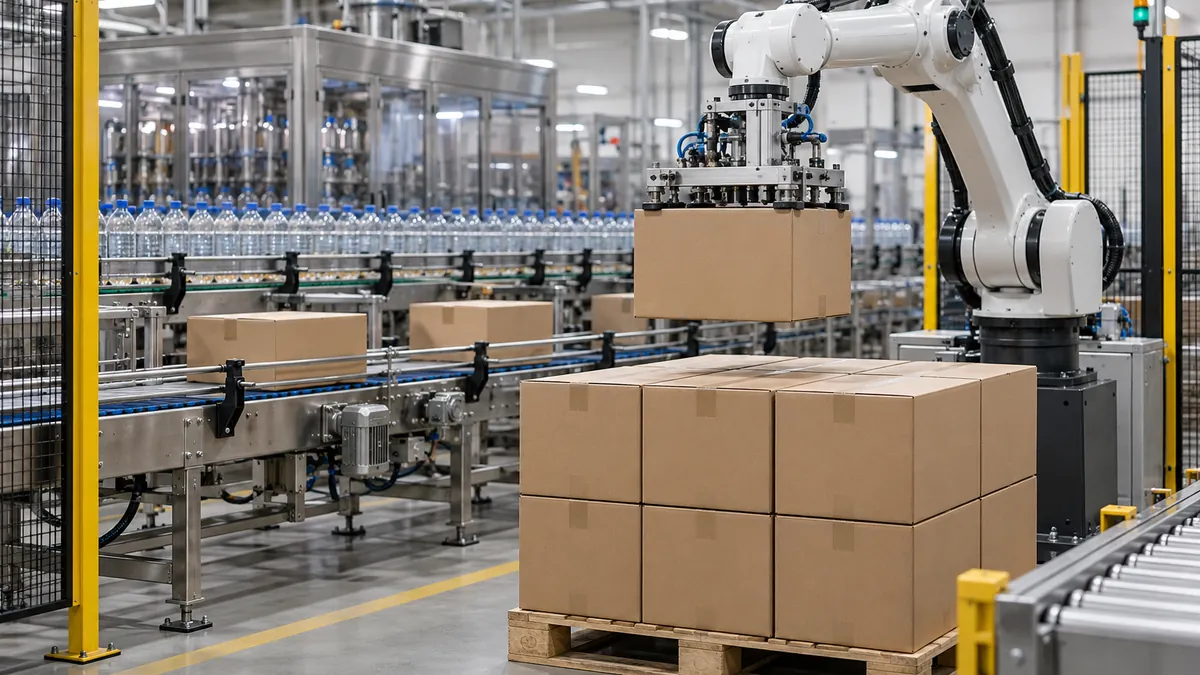
The supplier says Raumland handles products for multiple wine producers and uses saved programs for different carton characteristics. In the described setup, a vacuum gripper handles cartons from a conveyor and the system uses two pallet positions. This provides a useful starting point for analysing a varied operation, but does not establish how quickly every possible carton change can be performed.
Begin with a list of actual carton dimensions, weights, surface materials and pallet patterns. Include partially filled cases, seasonal packaging and the heaviest expected load. The robot's rated payload must account for the gripper and any other carried equipment, not only the cartons.
Test the grip and the stack
Vacuum performance can be affected by porous or damaged cardboard, labels, dust and changes in carton shape. Test samples from normal production and agree what happens when a grip is incomplete or a carton shifts during transport. A dropped case can damage product and create a recovery task even when the robot itself has not faulted.
Evaluate the completed pallet for stability during wrapping, storage and transport. The appropriate stacking pattern depends on carton strength, pallet condition, load height and customer requirements. Check whether the system can detect a missing pallet, an incorrect layer or a case placed out of position.
Measure the whole shift
A supplier demonstration should include the time required to feed cartons, change programs, replace a full pallet and recover from interruptions. Record good cases palletised, missed picks, manual interventions, downtime and damage over representative production. Compare the result with the existing operation using the same mix and staffing assumptions.
Ask who can create or change a carton recipe and how an approved pattern is checked before use. A controlled test with the first pallet of a new product can catch errors before they affect a full shipment. Keep a record of recipe versions and the training provided to operators.
Plan safety and ownership
The complete installation needs a site-specific safety assessment covering robot motion, conveyors, grippers, pallet exchange and forklift traffic. Collaborative features alone do not establish that every layout can operate without additional safeguards. Agree on safe access, emergency stops and isolation for maintenance with qualified personnel.
Calculate the investment with fixtures, conveyors, programming, training, maintenance and support included. The Raumland case illustrates one approach to handling varied cartons; the right solution depends on the buyer's products, available space, production schedule and quality requirements.
Prepare support for busy periods
Ask the integrator for spare vacuum components, service contacts and clear recovery instructions before acceptance. During peak bottling periods, a short stoppage can affect upstream equipment, so agree how the line will pause or use a manual alternative. Train staff on safe pallet exchange and on recognising cartons that do not meet the robot's approved handling limits.
Explore our supplier directory or contact the team with your packaging requirements.