

Pharmaceutical Isolator Robots: What Buyers Should Validate
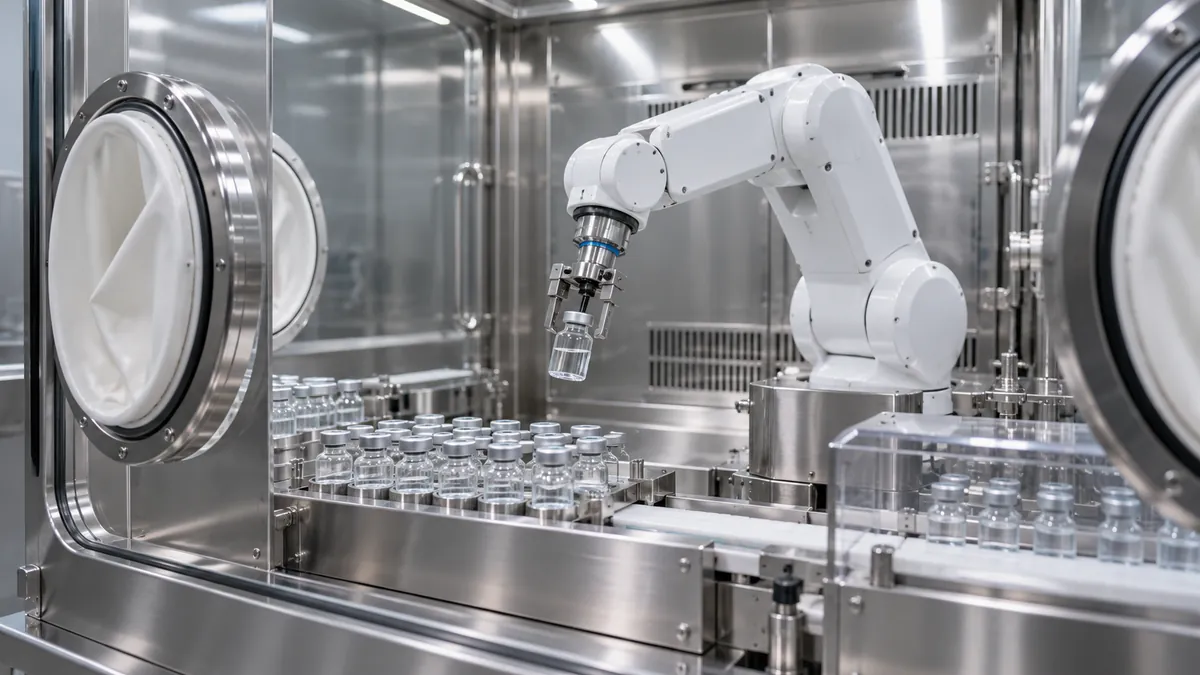
A robot intended for pharmaceutical production must be assessed as part of the complete controlled environment, not just by its payload and speed. Kawasaki's 1 July 2025 announcement of the MC006V describes a six-axis model designed for pharmaceutical and medical applications, including repeated exposure to vaporised hydrogen peroxide. This is a review of a previously announced product, not a new launch. Published 2026-10-31 04:16:05 -04:00 (America/New_York).
Read specifications in context
Kawasaki lists a maximum payload of 6 kg, maximum reach of 610 mm and positional repeatability of plus or minus 0.03 mm for the announced model. It describes design features for clean environments and resistance to a decontamination agent. These specifications concern the robot as described by the manufacturer; they do not establish that a complete line meets a particular site's quality requirements.
When comparing equipment, check the exact configuration, operating conditions, tooling and documentation. The carried load includes the end effector and any cables or accessories, as well as the product. Verify that the robot can access every necessary position inside the isolator without obstructing other equipment or maintenance.
Evaluate the complete environment
Materials, seals, cables, grippers and fixtures may respond differently to cleaning and decontamination. Request compatibility evidence for the chemicals, concentrations, exposure cycles and temperatures planned at the site. The manufacturer and qualified quality personnel should determine the validation approach for the actual equipment and process.
Airflow and access matter too. A robot that fits geometrically may still interfere with planned airflow or create surfaces that are difficult to clean. Review the layout with the isolator supplier and the site's engineering team. Define how components are inspected and replaced without compromising the controlled environment.
Build a representative acceptance plan
Use the real containers, trays and tooling expected in production. Test normal operation, missing or misaligned items, stops and recovery. Measure handling accuracy and damage, but also document interventions, cleaning and any changes needed to maintain environmental controls.
Agree how robot programs, process recipes and maintenance events are recorded. A change to a gripper, cleaning agent or motion path may require assessment under the site's change-control process. Ensure that records are accessible to authorised quality and engineering staff throughout the equipment's life.
Consider service and total cost
Ask who supplies spare seals, cables and tooling, how service access is managed and what training is included. The budget should cover integration, validation, environmental monitoring and downtime as well as the robot. Check availability and local technical support with the supplier before committing to a project schedule.
Finally, carry out a risk assessment of the complete cell and confirm applicable pharmaceutical requirements with qualified professionals. A supplier's clean-environment claim is useful evidence to investigate, but it is not a substitute for site-specific qualification or a guarantee of product sterility.
Plan the handover
Before equipment is accepted, agree on maintenance instructions, calibration records and the responsibilities of the robot and isolator suppliers. Train the people who will respond to an incomplete cycle or equipment fault. Document a safe route to recovery and review it with the quality team so an unusual event does not lead to an unrecorded change in the production process.
Browse our supplier directory or contact the team with your automation requirements.