

Stereo Cameras for Mobile Robots: What to Test Outdoors
Choosing a stereo camera for a mobile robot involves more than comparing image resolution. On 28 October 2026, oToBrite announced plans to demonstrate a stereo vision module and a connection to a YUAN computing platform at ROBOTWORLD in South Korea. The company describes the planned demonstration for 4–7 November; it should not be mistaken for a completed field validation. Published 2026-10-31 04:20:45 -04:00 (America/New_York).
What the supplier described
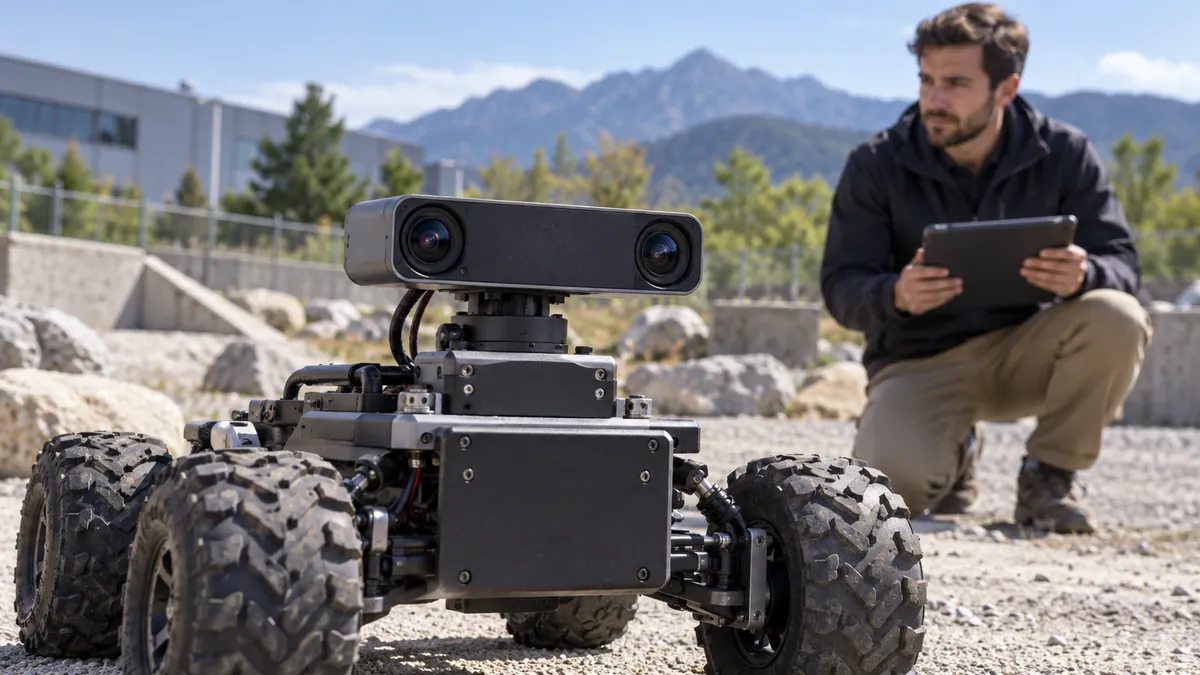
oToBrite says the camera module was developed with indie and is available in 60 mm and 120 mm baseline configurations. It describes synchronised exposures and an IP69K rating, and says the longer baseline version is intended for outdoor perception at distances up to 20 metres. These are supplier claims; actual usable range and depth accuracy depend on conditions and integration.
The company also announced a planned interface demonstration with YUAN. Before buying, confirm the exact camera, computing hardware, software versions, cables and supported interfaces. A successful exhibition connection does not automatically prove that another robot's complete perception system will meet its operating requirements.
Define the environment and task
List the objects and obstacles the robot must detect, their size, distance and expected movement. Include shadows, bright sunlight, rain, low-texture surfaces and reflective materials where relevant. Stereo systems may struggle under some conditions, so identify how the robot behaves when confidence is low or depth information is unavailable.
Camera placement affects both field of view and protection from vibration, dirt and accidental impact. Check mounting stiffness, cleaning access and cable routing. The stated enclosure rating should be verified for the exact assembled configuration and does not guarantee reliable perception when lenses are obscured.
Test timing and data flow
The announcement describes hardware synchronisation between the cameras. Integrators should measure timing across the full chain, including exposure, image transfer, processing and robot response. If several sensors are fused, document how their clocks are aligned and how late or missing frames are handled.
Use repeatable tests with reference measurements at the distances and speeds relevant to the application. Record missed obstacles, false detections, depth errors and recovery after data loss. Include changes in lighting and lens contamination rather than testing only a clean sensor in a controlled room.
Plan maintenance and responsibility
Agree who calibrates the cameras, how calibration is checked after impact or replacement, and how software updates are validated. Review access to recorded images and the support available in the operating country. If the perception system contributes to a safety function, qualified specialists must assess the complete system and applicable requirements.
Budget for integration, testing, computing hardware, cleaning and support in addition to the sensor. The planned demonstration is a useful opportunity to ask for details, while a representative field trial is the appropriate basis for an adoption decision.
Agree on test ownership
The camera supplier, robot maker and integrator should agree who measures end-to-end performance and who investigates a failure. Preserve the test conditions and reference data so results can be compared after a software or hardware change. Establish a safe fallback for conditions outside the tested range and train operators to recognise when that fallback is required.
Explore our supplier directory or contact the team with your vision requirements.