

Nursery Robots: Testing Seedling Container Feeding
Nursery automation can begin with a repetitive container-handling task rather than the most delicate step of growing a plant. A Universal Robots customer case describes Osaka Nursery in Japan using a robot to place containers onto a conveyor ahead of soil filling. The supplier-published case is a historical example; it does not establish the same savings for another nursery. Published 2026-10-31 04:22:39 -04:00 (America/New_York).
What was automated
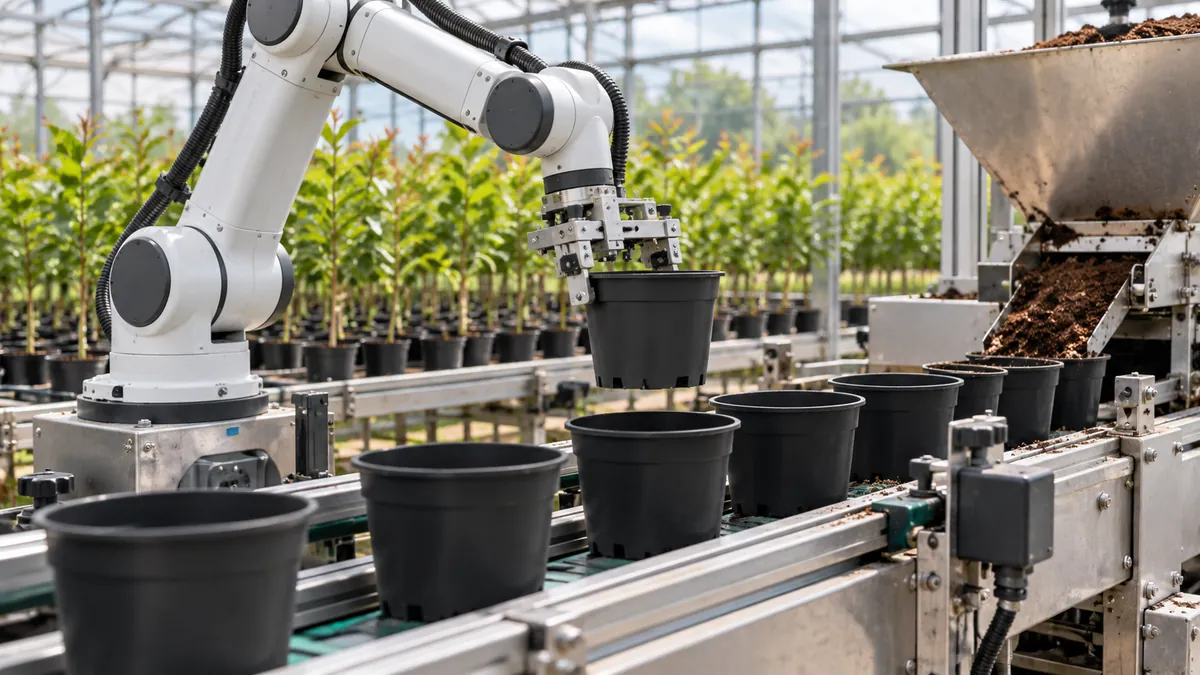
The case says a UR10e robot places containers on a conveyor at a set rate, after which an automatic feeder adds soil. It reports that the task previously required two people and could then be performed by one, with the other worker reassigned. The account concerns container placement; it should not be described as proof that all transplanting or cultivation was automated.
The supplier also notes an early problem: stacked containers sometimes stuck together, so more than one was picked. The integrator adjusted the end effector and added a separation device. This detail illustrates why the design of a feeder can matter as much as the robot arm itself.
Test the actual containers
Provide samples from normal purchasing batches, including variations in thickness, wear, moisture and nesting. Ask the supplier to demonstrate how individual containers are separated and how the system detects a double pick, missing pot or incorrect orientation. Include a procedure for removing damaged containers safely.
Measure the rate of correctly placed containers over a representative period, not just the fastest robot motion. Record manual intervention, jams, cleaning and any effect on the downstream soil feeder. The right performance target depends on the nursery's schedule and the capacity of the rest of the line.
Account for seasonal changes
Nursery work can vary by plant type and season. List all container formats, expected batch sizes and periods when the system may be idle. Check whether the gripper and feeder can accommodate a new pot without extensive modification, and measure the complete changeover including testing the first items.
Soil, moisture and plant material can affect sensors and mechanisms. Agree how the cell will be cleaned, which parts can be washed and how often the feeder requires maintenance. A robot specified for one environment should not be assumed suitable for every greenhouse without checking its operating limits.
Plan safe work and support
People may still load supplies, inspect seedlings and clear faults near the equipment. Qualified personnel should assess the complete installation, including conveyors, pinch points, access and emergency stops. Collaborative features do not automatically make every surrounding process safe.
Compare equipment, integration, training and service costs with measured labour and output over a full season. The nursery case shows a practical entry point for automation; a pilot using the buyer's own containers and workflow is the best way to assess whether it will work elsewhere.
Prepare for handover
Train operators to recognise a double pick and to stop and recover the line safely. Request instructions for cleaning, spare gripper parts and a named service contact. If the nursery uses several pot suppliers, agree how a new container is approved before routine production. Review trial records with the grower and integrator before accepting the cell.
Explore our supplier directory or contact the team with your nursery requirements.