
Open-RMF Python Adapters: Verify the Installed Bindings Before a Pilot
Published 2026-11-02 21:12:34 -05:00 (America/New_York). Sources checked 2 November 2026.
An example is not the deployed API contract
The Jazzy repository’s Python-adapter README describes bindings to C++ functionality and includes examples of command handles and update interfaces. It also contains cautions about experimental APIs and documentation generation. Buyers should therefore require the integrator to verify the installed bindings and their actual behaviour instead of assuming that a copied example establishes a supported production integration.
Record the package build, Python environment, relevant C++ libraries and application revision. This article uses the checked repository reference to frame an engineering review, not to promise compatibility across all releases. A tutorial that imports successfully can still differ from the API surface available in the buyer’s deployed environment.
Inspect the application’s binding boundary
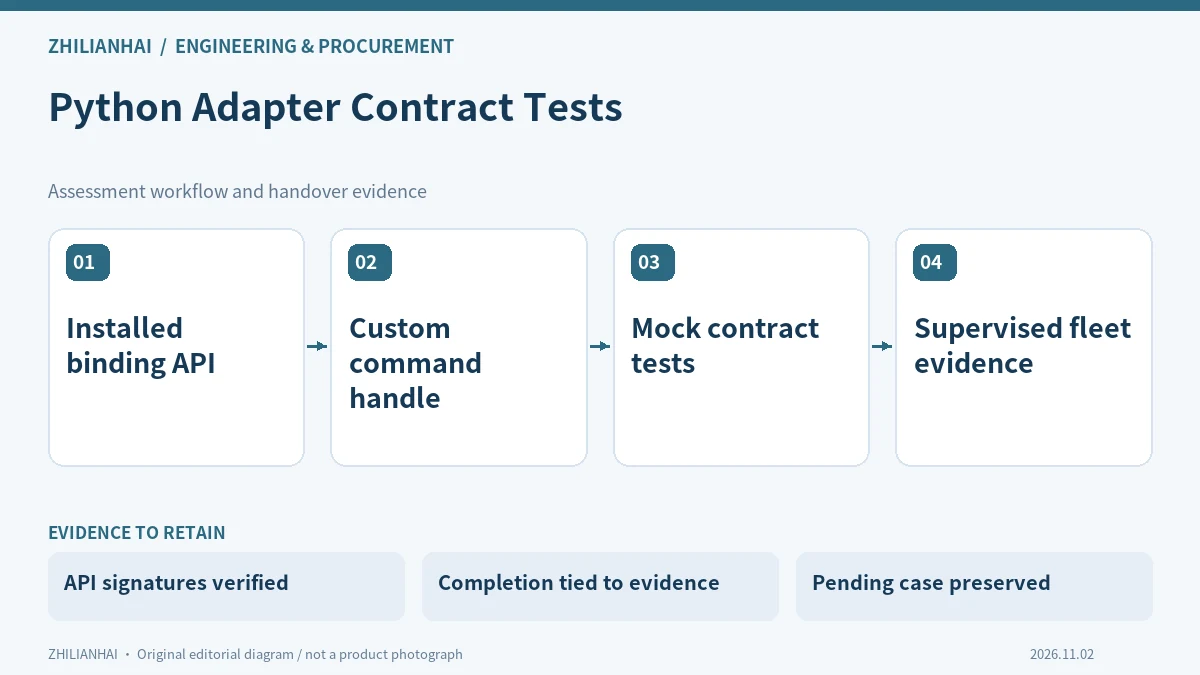
List the methods the adapter implements for the capabilities it claims to support. Identify their arguments, completion callbacks and state-update paths. A method invoked from C++ through a Python binding needs the correct contract on both sides. The buyer does not need to read every implementation, but should receive a concise map of these responsibilities.
Document what permits a completion callback to run. An example that immediately calls completion may illustrate binding syntax while omitting the actual robot work. The delivered adapter should connect completion to agreed fleet evidence. Keep state reporting separate so progress, interruption and final completion cannot be inferred from a single successful function call.
Use contract tests before a fleet trial
Create a small isolated test against the installed environment. Exercise the implemented methods with a mock fleet and verify expected callback count, argument interpretation and state updates. Include an operation that remains pending and one that is rejected through the application’s supported path. Retain the environment and test fixtures so another engineer can reproduce the observation.
Check the adapter after an approved dependency or package update using the same tests. Binding compatibility errors can appear before a physical robot is involved, making this a useful commissioning gate. Do not claim that passing a mock test validates timing, vehicle behaviour or traffic coordination in the actual facility.
Define support and acceptance boundaries
The handover should identify who maintains custom binding code and which upstream interfaces the application relies on. Include diagnostic evidence for a failed callback contract and the process for collecting a reproducible support case. Keep illustrative examples clearly distinct from the application’s implemented capabilities, especially where a demonstration bypasses real fleet communication.
Acceptance should show the buyer the verified environment, a normal contract test and the agreed incomplete-operation case. Confirm that callback completion is linked to genuine task evidence in the later supervised fleet pilot. This creates a traceable path from library example to installed adapter. It does not certify fleet safety, guarantee compatibility with every vendor API or remove the need to validate the complete site workflow with qualified personnel.
Keep callback ownership explicit when Python and C++ objects interact. The support record should identify the responsible application boundary instead of describing every binding-related failure as a robot fault.
Source: Open-RMF Python fleet-adapter README (Open-RMF Python adapter README in Jazzy branch, checked 2026-11-02; installed APIs must be verified). The acceptance proposals above are editorial guidance, not reported project results. Compare robot models and manufacturer profiles, or discuss the integration requirements.