
VDA 5050: Define an Interface Acceptance Profile Before Buying
Published 2026-11-02 21:12:34 -05:00 (America/New_York). Sources checked 2 November 2026. This is an editorial engineering guide; suggested tests below are not reported product test results.
A protocol name is only the starting point
A buyer comparing mobile robots may receive several offers marked VDA 5050 compatible. Those words do not define which vehicle functions will work with the proposed master controller. The VDMA and VDA announcement for version 2.1.0 describes communication between vehicles and master control and introduces corridors for robots with greater navigation autonomy. It is a dated interface release, not evidence that every current product implements every supported behavior.
Treat the procurement deliverable as an agreed interface profile. Record the robot model, controller software, master-control build, protocol version and any optional capabilities. If one supplier uses a later version, establish the actual common feature set instead of assuming the newest implementation automatically solves integration. A demonstration with one robot does not establish compatibility for another model or controller revision.
Write down the operating contract
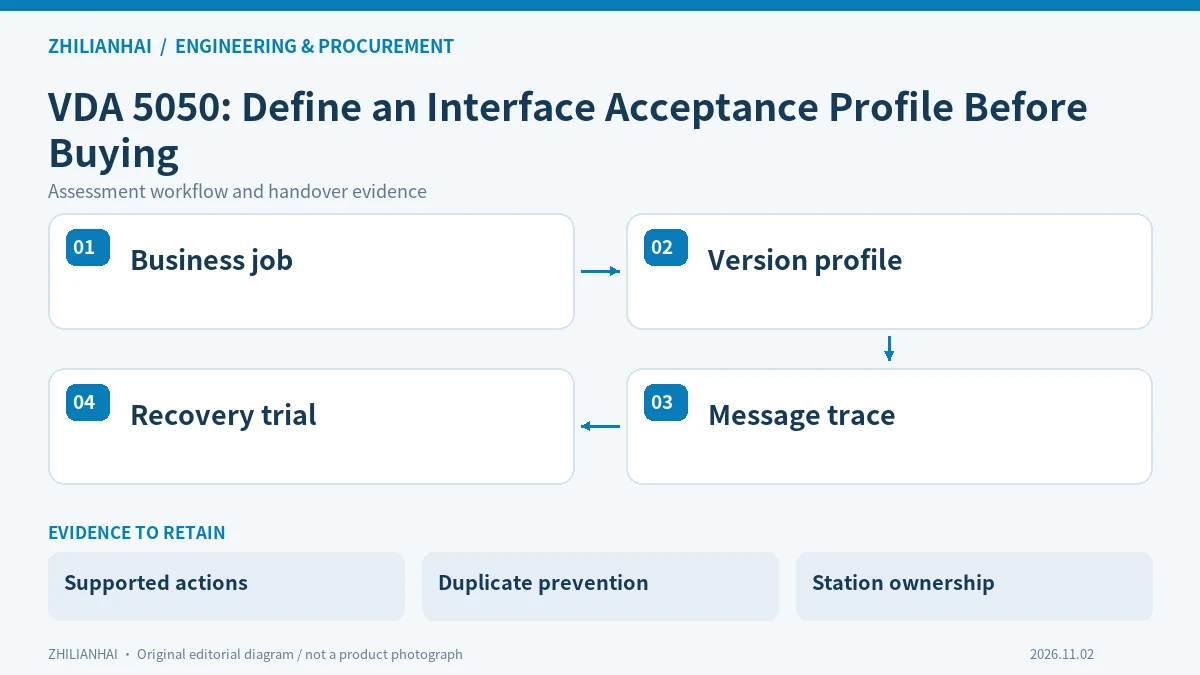
Describe the business job first: a tote must be collected at a named station, transported and handed over only after the receiving station confirms readiness. Then identify which party issues the transport order, interprets action completion and owns the station handshake. Keep the business identifier distinct from a controller session identifier so that operations staff can trace the same job through a restart.
Make a small capability table for each supplier: supported action and parameters, expected status response, timeout handling, cancellation behavior and the person responsible for an exception. Include the charging and load-handling actions that the application actually needs. An unsupported optional action is a design constraint to resolve, not a reason to silently translate it into an unrelated command.
Test interrupted work as well as successful travel
Start with a controlled integration environment using agreed maps and station identifiers. Exercise a normal order, an unavailable destination and a rejected action. Preserve the relevant messages and correlate their timestamps with observed vehicle behavior. Do not use a business dashboard green icon as the only evidence that a command reached the correct machine.
Next simulate a communication interruption and a master-control restart under the integrator’s approved test procedures. Determine whether the robot still has a valid order, whether the master resends it and how duplicate execution is prevented. For a load handover, verify which system knows whether the load has physically transferred. Recovery must reconcile the physical situation before a new business job is issued.
Separate interoperability from site approval
An interface test does not validate stopping distances, pedestrian separation or the complete installation’s safety functions. Those assessments require the responsible qualified parties and the applicable product and site requirements. Likewise, a version declaration is not an assurance about network segmentation, authentication or availability of long-term support.
Include a signed profile, trace examples, known unsupported functions and a repeatable regression test in the handover. Price the adapter, future version changes and support ownership separately from vehicle hardware. When an update arrives, rerun the affected scenarios against both suppliers’ actual releases. The useful outcome is a documented working combination, with clear exceptions and recovery, rather than a compatibility label alone.
Source and next steps
Reference: VDMA and VDA joint release on VDA 5050 version 2.1.0, 20 August 2024. The recommendations in this guide are our proposed procurement and validation questions, not requirements attributed to that reference. Review available robot models, compare manufacturer profiles, or contact our team with the intended task and site constraints.