
OPC UA Robotics: Ask for Data Meaning, Not Just a Connection
Published 2026-11-02 21:12:34 -05:00 (America/New_York). Sources checked 2 November 2026. This is an editorial engineering guide; suggested tests below are not reported product test results.
Start with the information model
OPC UA for Robotics Part 1 is a companion specification for vertical integration. The OPC Foundation’s online reference identifies the Robotics namespace and version 1.02 model identifiers. For a factory buyer, the important distinction is between establishing a connection to a server and agreeing what the exposed information means. A connected client can still associate the wrong component, unit or operating state with a production asset.
Before quoting integration work, identify the decisions that the factory application will make. Maintenance staff may need component identity and diagnostic context; production staff may need an availability view. Write separate data requirements for those uses. Avoid purchasing a broad list of tags without identifying who consumes them and what happens when a value is missing.
Make a small semantic contract
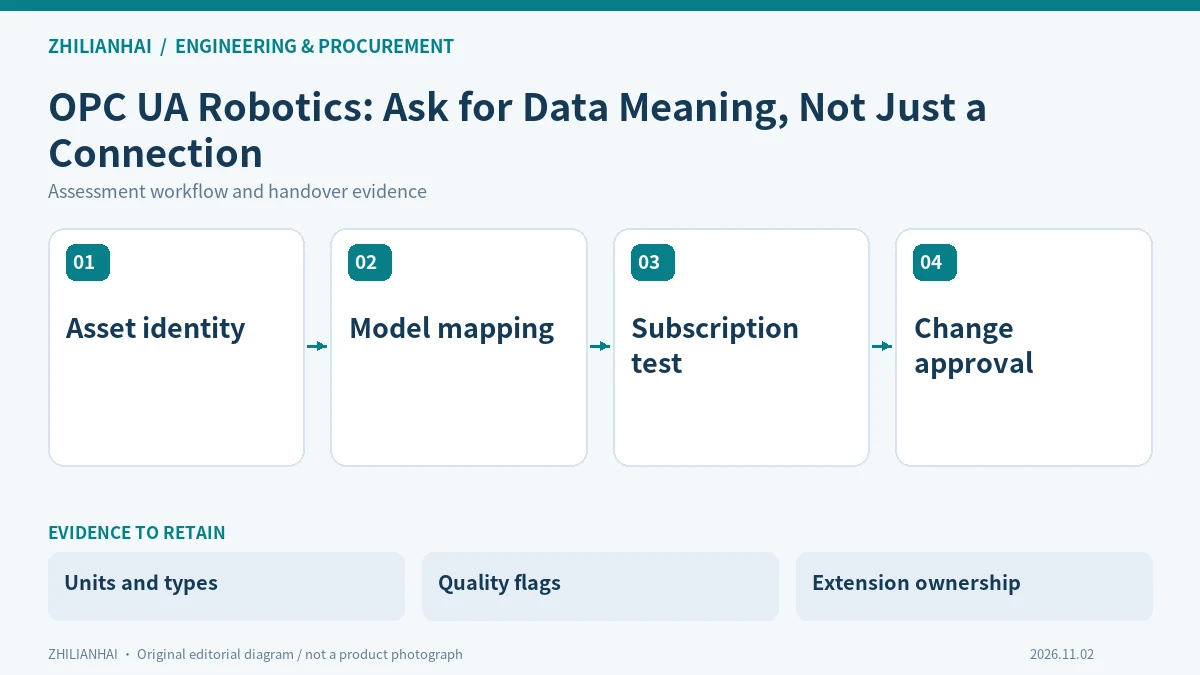
For each required item, record the asset identity, model reference, expected data type, engineering unit and conditions under which the value is meaningful. Add source timestamp and quality handling where relevant. The application’s display name may be translated or changed, so do not make a human-readable label the only durable identifier in an integration database.
Trace one controller, motion device and relevant component through the proposed server address space. Check how the integrator represents a cell containing several devices. If a required value is vendor-specific rather than covered by the agreed companion-model implementation, label it explicitly. Extension fields need their own documentation and support responsibility; they should not be passed off as universal across brands.
Validate subscriptions and changes
Run a read-only acceptance exercise against the exact server release proposed for the site. Compare known operating events with the values seen by the consuming application. Preserve a trace that includes identity, timestamp and quality information. Do not enable write methods merely to demonstrate connectivity; any control capability requires a separately authorized and assessed design.
Include a disconnected server, expired or rejected credentials and a simulated bad-quality value in the test plan. Confirm that an unavailable observation does not become a valid zero in a report. Also test a component replacement or a software update in an isolated setup: the consumer should detect a changed identity or model, rather than silently retaining an obsolete mapping.
Define ownership after commissioning
Assign one owner for the data dictionary and another, if necessary, for the factory application’s interpretation. Record who approves model changes, renews credentials and investigates a stale subscription. A maintenance dashboard becomes unreliable when every supplier assumes the other party owns the tag mapping. Put that ownership into the service handover, including a reproducible example client configuration.
The deliverable should contain the supported model version, chosen nodes, extensions, data-quality rules and the observed results of agreed trials. It should also state which information is intentionally unavailable. Such a package makes comparisons between robot suppliers more defensible while keeping the claims modest: a standards-based information model improves consistency, but it does not by itself certify production accuracy, cybersecurity or the complete robot cell.
Source and next steps
Reference: OPC Foundation reference for OPC UA for Robotics Part 1, version 1.02. The recommendations in this guide are our proposed procurement and validation questions, not requirements attributed to that reference. Review available robot models, compare manufacturer profiles, or contact our team with the intended task and site constraints.