
Robot Telemetry With Sparkplug: Make Offline Data Visible
Published 2026-11-02 21:12:34 -05:00 (America/New_York). Sources checked 2 November 2026. This is an editorial engineering guide; suggested tests below are not reported product test results.
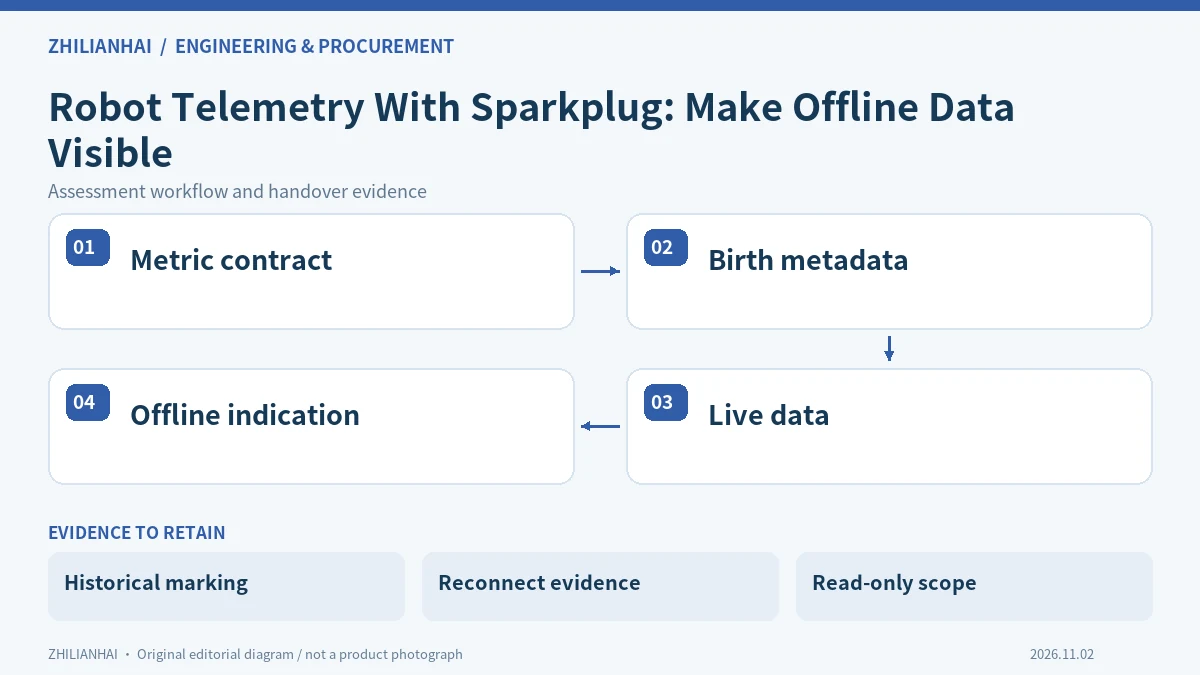
Separate a reading from its connection state
A robot monitoring screen can show a believable battery percentage or cycle count long after the source has disconnected. Eclipse Sparkplug 3.0.0 defines a topic and payload framework for industrial MQTT information exchange, including birth and death mechanisms. These mechanisms give an integration team a way to reason about connection state. They do not make a disconnected robot continue reporting or turn ordinary telemetry into a certified safety signal.
When evaluating a telemetry offer, ask what an operator sees when the source becomes uncertain. A last-known reading may remain useful for investigation, provided it is visibly historical. It becomes misleading when its presentation is indistinguishable from a fresh reading. Define this behavior for the monitoring use case before discussing how many dashboard tiles are included.
Specify identity, metric meaning and freshness
List the edge node, connected devices and metrics required for the operation. For each metric, agree its name, unit, originating system and update policy. A robot controller’s internal state and a business job’s state are different concepts; the integration must not collapse them into one status field without documenting the mapping. Include the provenance of calculated metrics.
Record how initial metadata reaches the receiver and how an application treats data before that metadata has been established. If aliases are used, verify how the receiver rebuilds their interpretation after a reconnect. A receiver that retains an obsolete association can display a correct numeric value with the wrong meaning, which is difficult to spot during a normal demonstration.
Exercise the whole reconnection sequence
Test a normal start, a graceful disconnect and a sudden loss of the network in an isolated or otherwise approved environment. Observe node and device availability separately. The goal is not to force the shortest possible timeout, but to confirm that the chosen timeout and operator response are suitable for the intended monitoring decision. Keep a timestamped record of the observed transitions.
After reconnection, check that the receiving application rebuilds its view from current metadata and that old readings remain distinguishable. Introduce an allowed metric-name or unit change in a test configuration and verify how the consumer detects it. Measure any period during which monitoring is incomplete, and define whether reports exclude that period or mark it as missing.
Keep monitoring and command authority distinct
A telemetry project should document whether it is read-only. If commands are in scope, their authorization, acknowledgement, allowed operating states and recovery need separate design and testing. MQTT transport availability alone does not prove that a physical action occurred. Equally, a last will or death notification is not a substitute for the robot installation’s assessed protective functions.
Request a delivered configuration, metric dictionary, message trace, reconnection evidence and monitoring runbook. Assign ownership of broker operation, edge-node updates and application alarms. Include a plan for credential renewal and controlled changes. The purchasing question then becomes whether the supplier can deliver trustworthy state information through expected interruptions, rather than whether it can produce an attractive screen while every connection is healthy.
Source and next steps
Reference: Eclipse Sparkplug 3.0.0 specification. The recommendations in this guide are our proposed procurement and validation questions, not requirements attributed to that reference. Review available robot models, compare manufacturer profiles, or contact our team with the intended task and site constraints.