
Robot Software Bills of Materials: What Buyers Should Receive
Published 2026-11-02 21:12:34 -05:00 (America/New_York). Sources checked 2 November 2026. This is an editorial engineering guide; suggested tests below are not reported product test results.
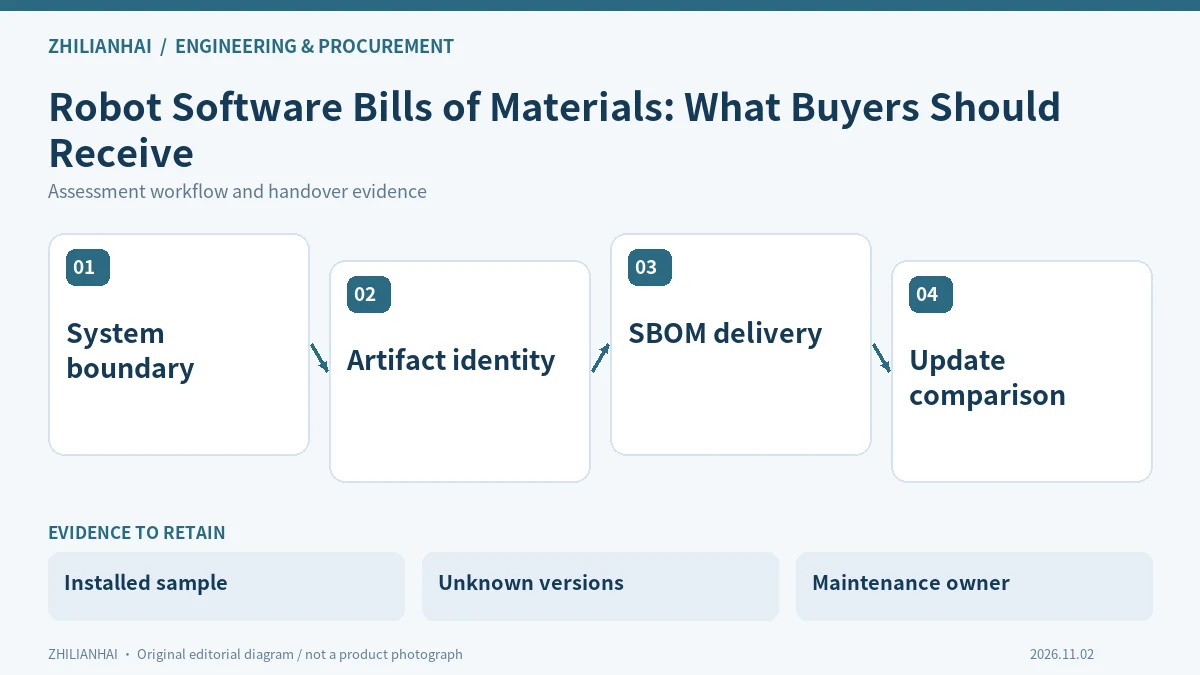
Define the delivered software boundary
A robot system may include controller firmware, a vision computer, a gateway, vendor extensions and a cloud service. An inventory of the workstation’s operating-system packages does not automatically describe all of them. SPDX 3.0.1 provides a structured specification for describing package and other supply-chain information. Buyers still need to agree which delivered systems the supplier’s bill of materials covers.
Begin with an architecture drawing and identify each software-bearing component. Mark components operated by the customer, operated by the integrator and supplied as a remote service. Ask whether the SBOM describes a build artifact, an installed image or a running configuration. Those are related but different observations. A document generated during an early prototype may no longer represent the system delivered to the factory.
Ask for identifiers that can be checked
A useful handover names components precisely enough to distinguish releases. Record the SBOM format and version, the creation date, the producer and the corresponding robot-system release. Where available and appropriate, include checksums or other durable artifact identifiers. Component relationships help an investigator understand whether a library is actually included in a delivered image or merely used by an unrelated development tool.
Document uncertain fields rather than filling them with plausible guesses. For example, an unavailable component version should be identified as an information gap with an owner and resolution date. A supplier’s legal or security team should handle the interpretation of license obligations; a software inventory is evidence for that review, not an automatic declaration that every use has been cleared.
Connect the inventory to maintenance decisions
Choose an example advisory relevant to a component in the agreed boundary and ask the supplier to trace the affected release to the delivered system. The exercise should identify who investigates applicability, who approves a change and what operational testing is required before installation. A component-name match alone is not proof that a particular vulnerability is exploitable in the robot’s configuration.
Then compare the SBOM before and after a controlled software update. Determine whether the supplier provides a new complete inventory, a change record or both. Retain the earlier version with the matching software release so an incident can be investigated retrospectively. Do not overwrite a historical SBOM with the latest one and thereby lose the description of an earlier deployment.
Include evidence in the commercial scope
State the required delivery timing, machine-readable format, update trigger and retention period in the purchase specification. Assign responsibility for bundled third-party components and for information that an upstream vendor must provide. Also agree how sensitive architecture details are shared with authorized customer staff without putting the inventory on a public website.
Accept the deliverable by checking it against a sampled installed component and the agreed system boundary. Keep the evidence of that comparison with the installation record. An SBOM does not replace access control, secure updates or technical support, but a maintained and verifiable inventory can make those activities more focused. Its value is the ability to answer a concrete maintenance question about the delivered robot system, not the presence of a file with a fashionable name.
Source and next steps
Reference: SPDX specification version 3.0.1. The recommendations in this guide are our proposed procurement and validation questions, not requirements attributed to that reference. Review available robot models, compare manufacturer profiles, or contact our team with the intended task and site constraints.