
Used Industrial Robots: Verify Identity Before Comparing Price
Published 2026-11-02 21:12:34 -05:00 (America/New_York). Sources checked 2 November 2026. This is an editorial engineering guide; suggested tests below are not reported product test results.
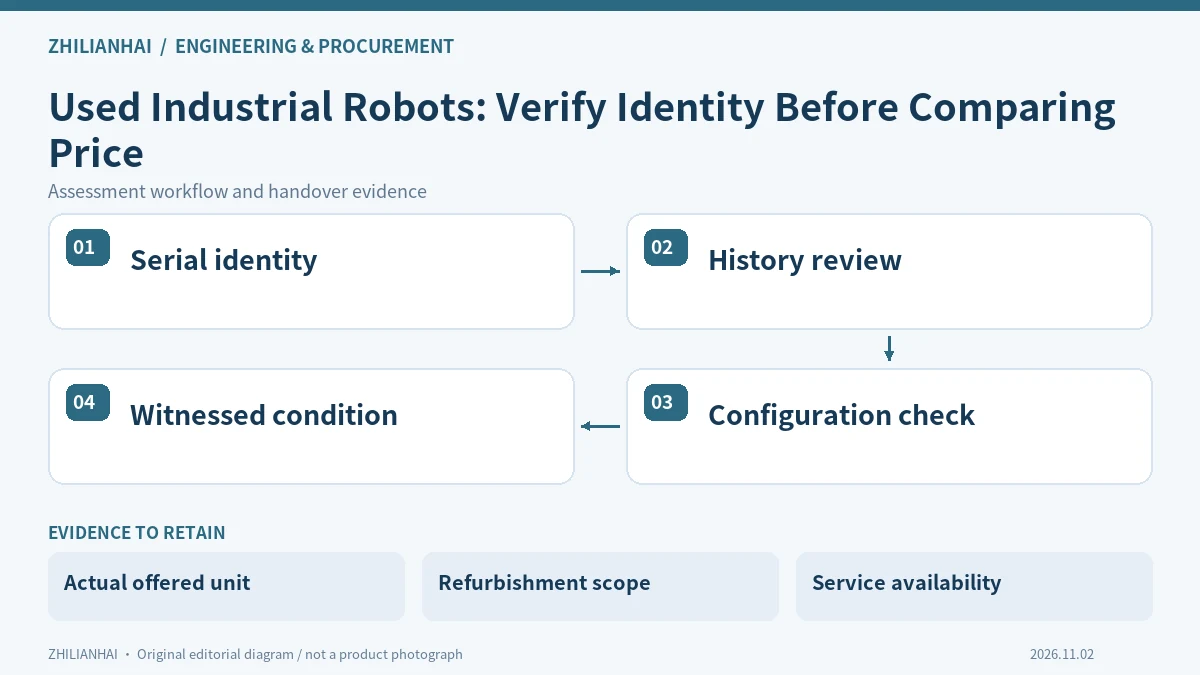
Used and refurbished need an evidence trail
KUKA’s used-robot service page describes buying or renting used equipment and tested quality. That is evidence of an OEM service offering, not proof that every robot advertised by an unrelated seller has been refurbished to the same scope. The buyer’s first task is to connect the offered physical unit to its identity, configuration and documented condition.
Request the robot and controller model, serial identifiers, year information and the exact equipment included in the sale. Photographs should show the offered unit and its identification plates, with commercially sensitive details shared through an appropriate channel. A stock photograph may help illustrate a model, but it cannot establish the condition or identity of the equipment being priced.
Separate known history from missing history
Ask for available service records, major component replacements, prior application and the basis of any operating-hour figure. Treat absent records as an uncertainty to investigate, not as evidence that the equipment has had an easy working life. Storage conditions and relocation can matter even when the seller reports few operating hours.
Where refurbishment is claimed, request an itemized scope: inspected parts, replaced parts, functional checks and remaining exclusions. Identify who performed the work and which report belongs to the offered serial number. An invoice for repainting or cleaning does not establish the condition of gears, bearings, cables or electronic components. Any statement about remaining useful life needs its own defensible basis.
Review the controller and integration package
An attractive robot arm may still be unsuitable if the controller, compatible cables, required software options or service tools are missing. Compare the complete package against the intended application. Ask the supplier to identify supported software versions and the availability of replacement parts and qualified service for the destination market.
Clarify rights and transfer arrangements for proprietary software, support subscriptions and any application-specific programs with the relevant supplier. Do not assume that a program stored on an old controller can lawfully or practically be reused in a new factory. A new integration also requires its own assessment of tooling, fixtures, protective measures and operating procedures; prior operation elsewhere does not approve the new installation.
Make the condition trial and exclusions contractual
Have competent personnel define an appropriate inspection and witnessed functional trial for the intended purchase. Record the configuration, observations, fault history available at inspection and any limitations on the trial. Avoid interpreting a short video of unloaded movement as evidence that the unit can achieve the required process quality under the proposed load and duty cycle.
The commercial comparison should include missing equipment, restoration work, transport, integration and support, as well as the purchase price. Describe any warranty or return terms exactly as the seller offers them; do not infer them from the term refurbished or from an OEM’s general marketing page. A useful purchase file makes the equipment’s identity, observed condition and unresolved risks visible before payment and shipment, so that the buyer can compare a used system with a properly scoped new alternative.
Source and next steps
Reference: KUKA official used-robot services page. The recommendations in this guide are our proposed procurement and validation questions, not requirements attributed to that reference. Review available robot models, compare manufacturer profiles, or contact our team with the intended task and site constraints.