
Robot Rental Pilots: Measure Useful Work Before Committing
Published 2026-11-02 21:12:34 -05:00 (America/New_York). Sources checked 2 November 2026. This is an editorial engineering guide; suggested tests below are not reported product test results.
A short contract does not remove integration work
Rental can provide access to robot equipment without immediately buying the hardware. KUKA’s used-robot service page, for example, presents rental and purchase as available options. That example does not establish rental availability, pricing or service terms for a particular region or model. A buyer must obtain a written offer for the actual equipment, period and application.
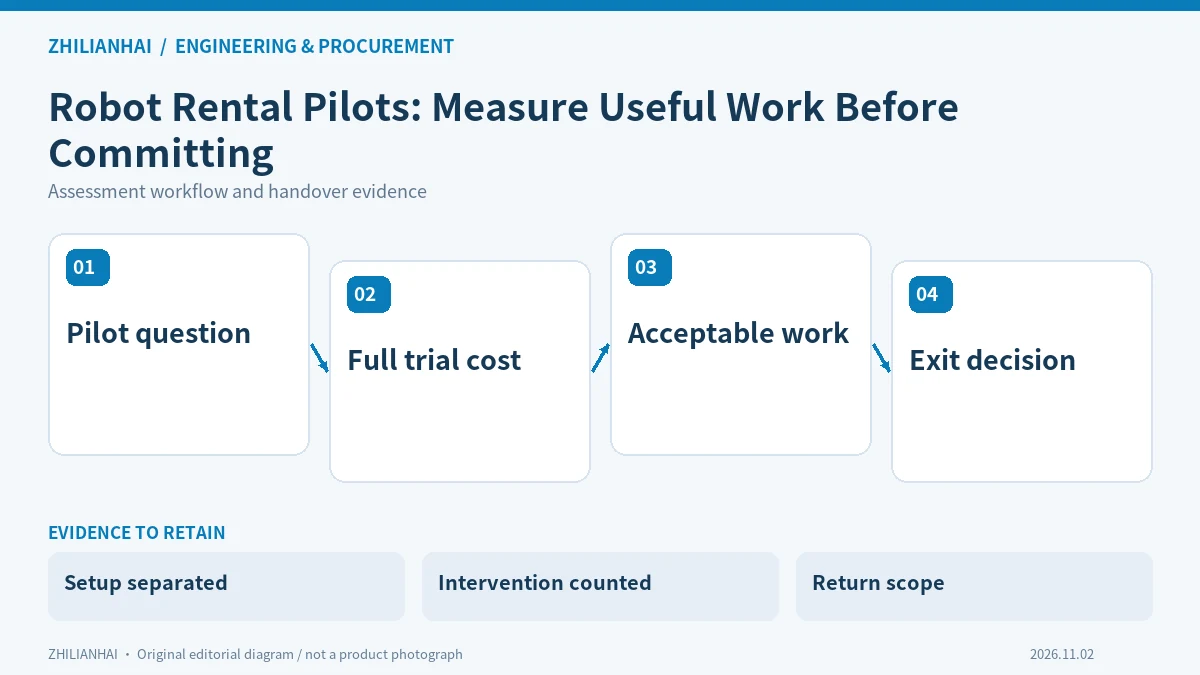
Define the purpose of the pilot before requesting a monthly figure. The question might be whether a known part family can be processed reliably, whether staff can manage exceptions or whether demand justifies a permanent cell. Those are different questions and may require different tooling, observation periods and support. A successful exhibition demonstration does not answer all three.
Calculate the cost of the experiment
Separate rental charges from transport, insurance where applicable, installation, tooling, programming, training and removal. Ask which costs are one-time, recurring or conditional on damage and extension. A robot that is inexpensive to rent may still be costly to integrate for a short trial. Do not treat an excluded cost as zero simply because the first quotation has not priced it.
Keep experimental setup time distinct from steady operation. Record when the equipment became ready for the agreed task and which hours were lost to changes requested by the buyer. This avoids attributing all development activity to poor robot availability or, conversely, presenting only a brief optimized run as the economics of the entire rental.
Measure completed acceptable work
Choose a useful-work measure tied to the actual business outcome, such as correctly processed parts or completed transport jobs accepted by the receiving process. Record failures, operator interventions, rework and inspection activity separately. The evaluation should make visible how much human effort is still needed rather than assuming that any machine movement represents labor saved.
Compare the pilot with an appropriate baseline for the same product mix and operating period. If a simple cost-per-acceptable-unit calculation is useful, state its cost boundary and include all relevant operating inputs. Do not generalize a result from a narrow sample to an annual return without showing demand, utilization and uncertainty. The purpose is to inform the next decision, not to manufacture a universal payback claim.
Agree the exit and expansion conditions
The rental agreement should identify the equipment configuration, permitted modifications, maintenance responsibilities and the condition expected at return. Clarify what happens to application programs, fixtures and site data. If the pilot may become a purchase, specify how the offered purchase is scoped; do not assume that rental payments will automatically be credited toward ownership.
Set a review date and a short decision record: proceed, extend with a defined question, revise the application or return the equipment. Preserve the observations and limitations even when the answer is not to buy. A well-designed rental pilot is valuable when it reduces uncertainty about a specific application, with a clear cost and handover trail. Merely having a robot on site for a month is not evidence that the business case has been validated.
Source and next steps
Reference: KUKA official used-robot service page, including rental and purchase options. The recommendations in this guide are our proposed procurement and validation questions, not requirements attributed to that reference. Review available robot models, compare manufacturer profiles, or contact our team with the intended task and site constraints.