
Robot Cell Acceptance: Keep Factory and Site Evidence Separate
Published 2026-11-02 21:12:34 -05:00 (America/New_York). Sources checked 2 November 2026. This is an editorial engineering guide; suggested tests below are not reported product test results.
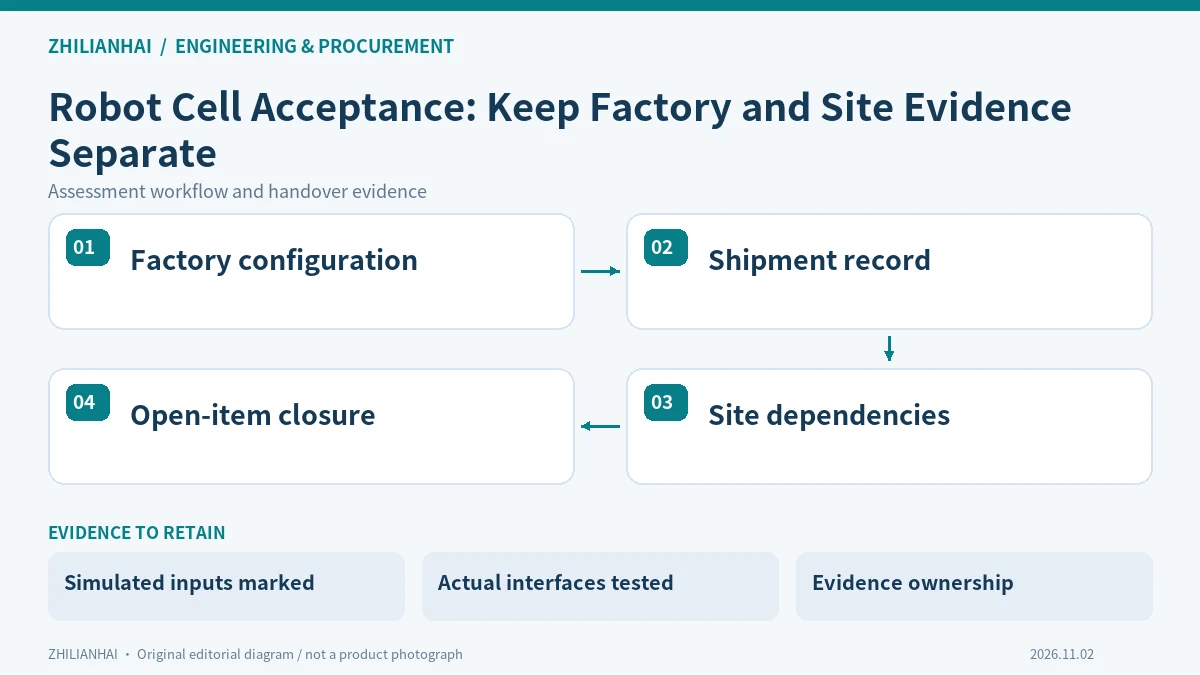
Different locations answer different questions
A robot cell can perform correctly at the integrator’s workshop and still require work after arriving at the customer site. Universal Robots’ deployment guidance identifies installation considerations such as mounting, payload configuration and tool reference settings for the products it covers. That is a useful reminder that performance evidence belongs to a defined physical configuration. It is not a universal factory-acceptance or site-acceptance standard.
Define which project questions will be answered before shipment and which require the actual site. A factory trial may establish program flow, tooling behavior and a controlled part-handling sequence. Site work may need to verify real utilities, upstream and downstream interfaces, access arrangements and the intended operating environment. The two sets of evidence should be connected, but they should not be presented as interchangeable.
Freeze the configuration being demonstrated
Record the robot and controller identities, software release, tool configuration, fixtures and sample material used in each agreed trial. Identify temporary equipment, simulated signals and manual actions. If an operator supplies a signal that the customer’s production system will eventually provide, label that substitution rather than allowing the demonstration to imply that the final interface has already been proved.
Use an acceptance matrix that connects each requirement to the test conditions, observed result and evidence file. Retain failures and corrective actions alongside successful runs. A video can support a record, but it should not replace a description of the inputs, intervention and output criteria. The buyer needs to know whether the demonstration used the proposed configuration and representative material.
Repeat the site-dependent evidence
Before site trials, have the responsible personnel confirm the prerequisites for the installed equipment and intended work. Check that transport and reassembly have not left undocumented configuration changes. Reconcile identifiers and approved settings with the pre-shipment record. Any required safety assessment, validation or inspection remains the responsibility of the qualified parties under the applicable requirements.
Exercise the actual interfaces with surrounding processes. Include a missing input, a rejected output and recovery from a controlled interruption where the approved plan permits it. Determine which party resolves an exception that crosses supplier boundaries. If a site dependency is unavailable, keep the associated test open rather than marking it passed using a workshop simulation.
Close the project with explicit remaining work
An open-item list should name each unresolved issue, its operational consequence, owner and closure evidence. Distinguish a documentation correction from a condition that prevents the intended operation. Any commercial decision to accept with open items should be clearly authorized and should not be disguised by changing the technical result.
The handover should preserve the agreed test matrix, release configuration, training records and remaining support responsibilities. Link subsequent changes to the affected tests so that a later tool or program update can be assessed efficiently. A disciplined acceptance process is valuable because it shows what was demonstrated, where it was demonstrated and what still depends on the installed site. It does not promise that a single successful trial will predict every future production condition.
Source and next steps
Reference: Universal Robots Important Deployment Points, CB-Series and e-Series guidance. The recommendations in this guide are our proposed procurement and validation questions, not requirements attributed to that reference. Review available robot models, compare manufacturer profiles, or contact our team with the intended task and site constraints.