
Robot Energy Estimates: Measure the Whole Cell and the Work
Published 2026-11-02 21:12:34 -05:00 (America/New_York). Sources checked 2 November 2026. This is an editorial engineering guide; suggested tests below are not reported product test results.
A catalogue value has a defined context
The cited UR15 manual separates a maximum average power figure from an approximate figure for a typical program. That distinction illustrates why a robot datasheet should not be treated as a measured annual energy bill for a complete application. The figures apply to the specified product context; they do not describe every trajectory, tool, peripheral or site operating schedule.
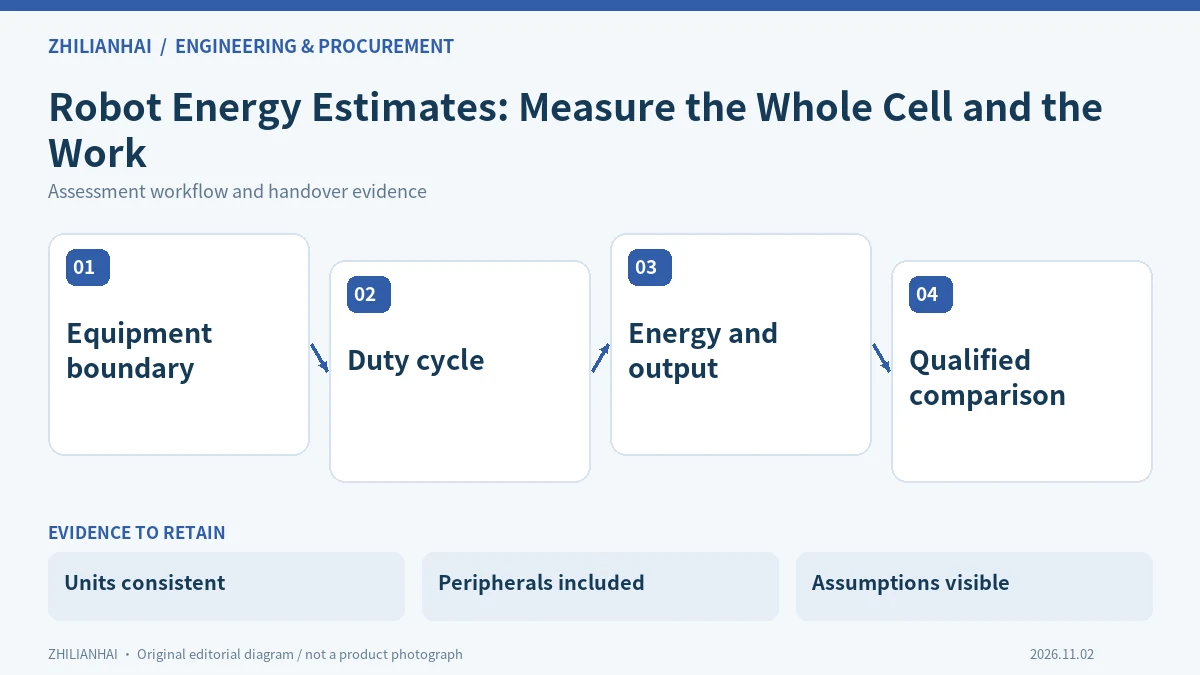
Begin an estimate with the equipment boundary. Identify the robot controller, end effector, vision hardware, conveyors, chargers where relevant and other services needed to perform the task. Decide which inputs will be measured directly and which remain separately estimated. A comparison becomes misleading when one offer includes peripherals while another includes only the robot arm and controller.
Describe the duty cycle
Record representative operating states such as production, waiting for parts, planned idle periods and maintenance. Define how much time the proposed application spends in each state, using observations or a clearly identified planning assumption. A brief continuous-motion demonstration may not represent a line that waits for material for much of the shift.
Choose trajectories, payloads and tool activity that reflect the intended job, within the equipment’s permitted conditions. If several product variants are important, measure or estimate their contributions separately. Keep the system release and operating settings with the record so that another engineer can understand what was evaluated. Do not change protective functions or exceed permitted operation in an attempt to improve a comparison.
Measure input and useful output together
Have qualified personnel select and install suitable measurement equipment and define the measurement interval. Electrical work and connection methods must follow site requirements. Capture enough of the operating pattern to include normal waiting and peripheral use. Instantaneous power and energy accumulated over a period are different quantities and should be reported with their units.
Relate energy to acceptable completed work where that measure is useful. A lower energy total may simply reflect fewer completed parts or more rejected output. Preserve production counts, interventions and relevant quality outcomes for the same interval. If compressed air or another utility is in scope, document the chosen measurement or allocation method rather than silently treating its contribution as free.
Use the result with appropriate limits
Report the boundary, product mix, duty cycle, measurement period and any missing inputs beside the result. Separate an observed value from a projection. An annual projection needs its assumed working hours, utilization and utility prices; these are customer-specific inputs, not universal facts supplied by a robot catalogue.
For purchasing, ask competing suppliers to address the same task and boundary, with uncertainty made visible. Compare energy alongside quality, throughput, maintenance and the ability to operate reliably under the intended conditions. Repeat the relevant measurement after a material process change if it affects the business case. A careful energy estimate supports a decision by making its assumptions testable, rather than assigning a fixed saving or carbon claim to every installation of one robot model.
Source and next steps
Reference: Universal Robots UR15 technical specifications, PolyScope X SW10.10 manual. The recommendations in this guide are our proposed procurement and validation questions, not requirements attributed to that reference. Review available robot models, compare manufacturer profiles, or contact our team with the intended task and site constraints.