
Returning a Robot: Plan Data Removal Before Equipment Leaves
Published 2026-11-02 21:12:34 -05:00 (America/New_York). Sources checked 2 November 2026. This is an editorial engineering guide; suggested tests below are not reported product test results.
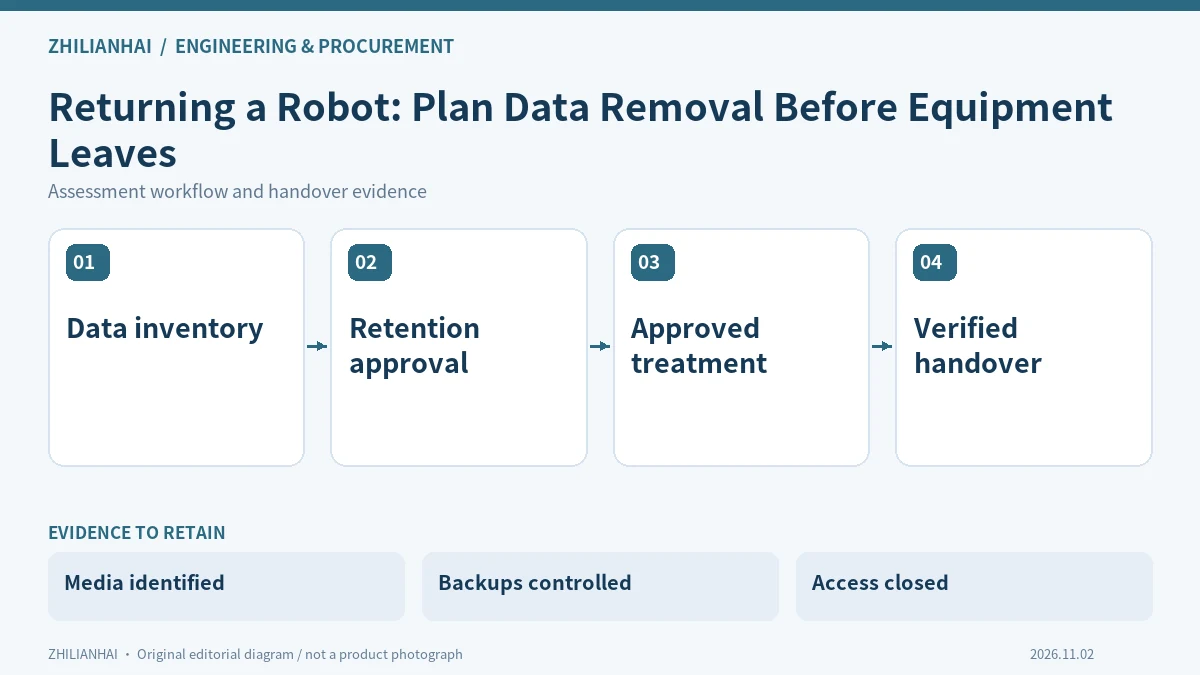
A robot return is also an information handover
A controller or service computer may hold application programs, production parameters, network configuration, images or support records. Returning a rental robot or selling a used cell can therefore transfer more than hardware. NIST SP 800-88 Revision 2, published in September 2025, addresses establishing a media-sanitization program according to information sensitivity and applicable techniques. It does not provide a single universal erase procedure for every robot controller.
Start planning before collection day. Identify the equipment and storage locations that may contain customer information, including removable media and any connected service computer. Separate customer-created data from supplier software and records that must remain with the equipment. Ask the manufacturer or authorized service organization which approved processes are compatible with the exact controller and storage technology.
Resolve retention and ownership first
Decide which records the business needs to retain and who is authorized to approve their retention and removal. Production, quality, maintenance and information-security teams may have different needs. The disposition plan should reconcile them before any destructive action is considered. This article is a planning guide, not an instruction to wipe a working machine or override record-retention obligations.
Where an authorized backup or export is required, identify the intended recipient, access controls and the corresponding equipment release. Check that the retained material can be interpreted and, where relevant, restored using approved tools. An unreadable export or an unexplained folder copied at the last minute is weak evidence that the organization has preserved the information it needs.
Choose an approved media-specific process
The responsible specialists should choose the sanitization approach for the identified media, sensitivity and future disposition. Obtain manufacturer guidance where controller operation, licensing or service functions may be affected. A general operating-system delete command or a factory-reset label is not enough evidence to conclude that all target information has become inaccessible.
Document the exact scope of the authorized work and keep the equipment out of unintended operation during servicing under site procedures. If storage cannot be handled as originally planned, escalate the exception rather than improvising a new process. The custody record should explain where the equipment and any removed media are held while the issue is resolved.
Verify the result and close access
Retain the approved disposition record, equipment and media identities, method used, responsible personnel and the evidence required by the organization’s program. Verification should establish whether the planned outcome was achieved for the relevant media and data scope. It should also record exceptions, rather than presenting a supplier’s generic certificate as proof for an unidentified physical unit.
Finally, review accounts, network access, remote-support arrangements and external services associated with the retired installation. Data removal from a controller and termination of a cloud or service account are separate tasks. Confirm who takes over the hardware and which information is intentionally supplied with it. A complete return file connects retained records, authorized removal, access closure and physical custody so that the equipment can change hands without an undocumented transfer of the customer’s operating information.
Source and next steps
Reference: NIST SP 800-88 Revision 2, Guidelines for Media Sanitization, September 2025. The recommendations in this guide are our proposed procurement and validation questions, not requirements attributed to that reference. Review available robot models, compare manufacturer profiles, or contact our team with the intended task and site constraints.