
Multi-Camera Bandwidth: Separate Transfer Limits From Processing Backlogs
Basler distinguishes device-link throughput limits, throughput information for current settings and transfer-reserve parameters. These are not measurements of host-side inspection capacity. A multi-camera review should follow data generation, shared transfer resources and completed decisions as separate stages, with evidence at the boundaries between them.
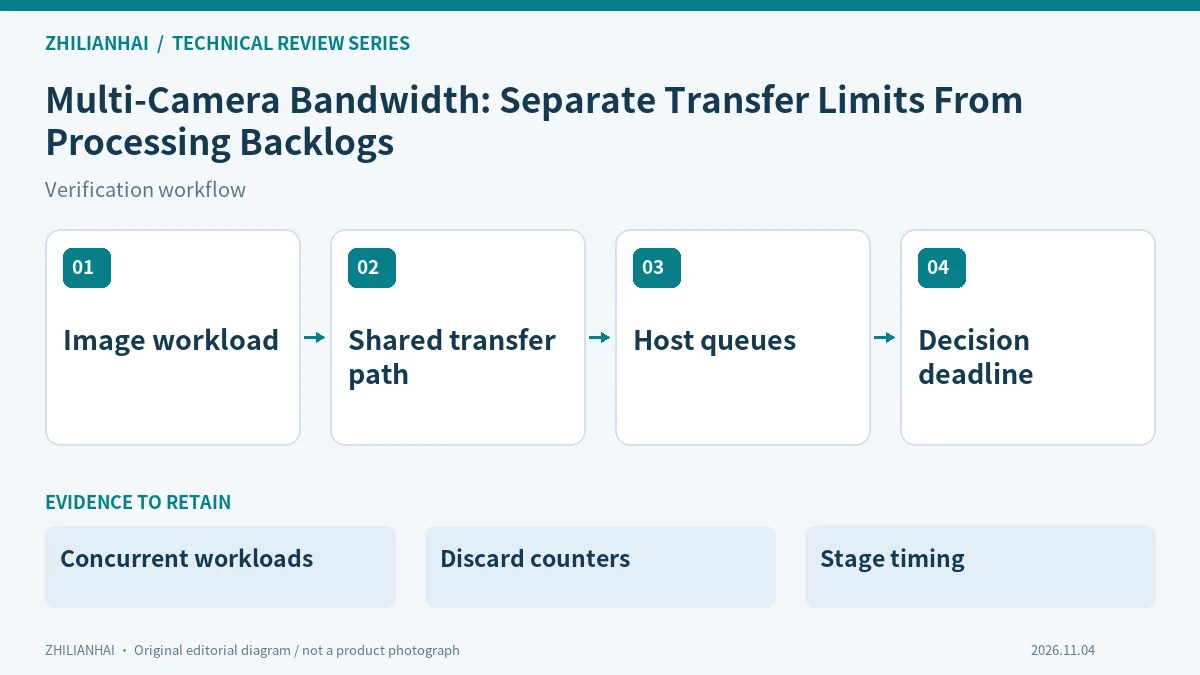
Start with the delivered image format
Record dimensions, pixel format, trigger conditions, metadata and actual output cadence for every camera. Estimate transfer and memory use from the formats actually transmitted and received. Sensor bit depth is not automatically the number of bytes occupied by a host-side pixel, and a converted image may require a second buffer.
Compare the estimate with counters available from the acquisition application. Where a documented throughput parameter uses an assumed acquisition rate, state that assumption. A calculated upper-bound figure is different from traffic measured during the current production condition. Keeping those meanings separate makes the budget useful when camera settings change or the site later adds another image consumer.
Map shared resources, not just camera ports
Draw the network adapters, switching equipment, uplinks, acquisition processes, storage and display paths. Separate physical ports do not establish independent downstream capacity. Mark every point where traffic or processing converges and name the person responsible for its configuration.
Record a single-camera baseline, then repeat the agreed concurrent combinations with their actual dimensions, formats and trigger conditions. The report should show where load increases. A supplier's best result from one isolated camera cannot explain a site configuration where several acquisitions, a preview display and image saving all compete for the same resources. Keep the complete topology revision with the corresponding measurements.
Separate transfer limits from processing queues
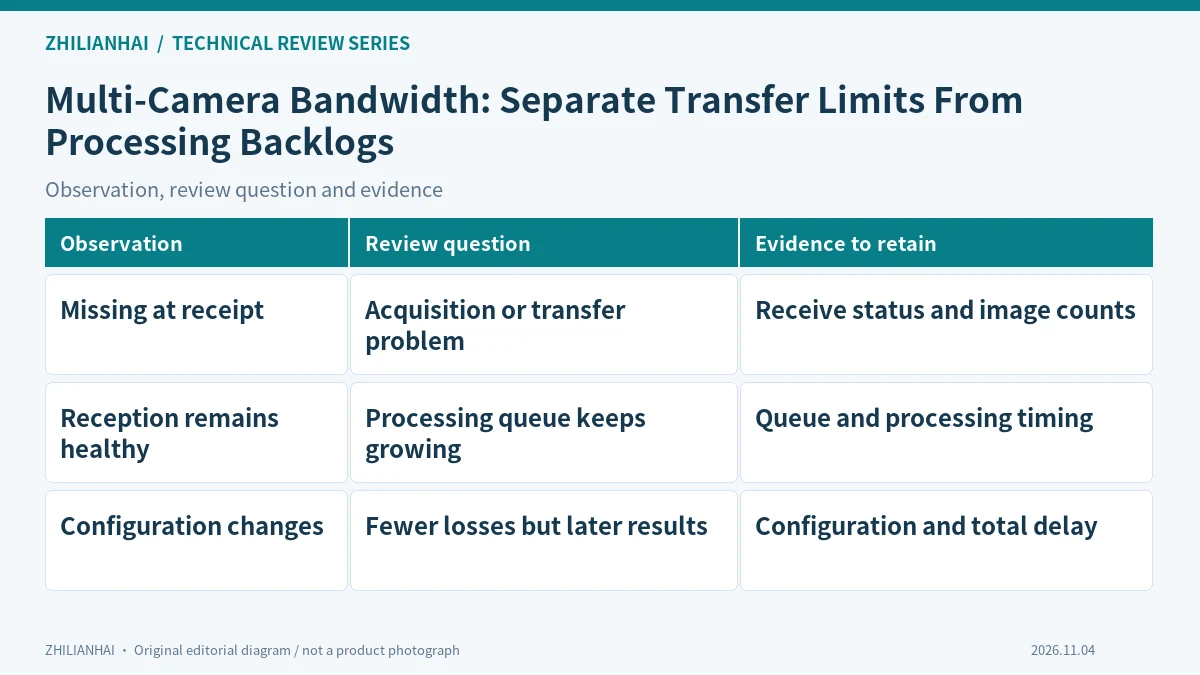
Retain acquisition, host receipt, processing start and result completion observations for the same image, using suitable timing or equivalent state records. Continuous reception followed by a growing processing queue points to a different investigation from missing acquisitions at the receiving stage. Format conversion, computation and image saving deserve separate attention.
Count inputs, completions, discarded items and work still waiting. An average processing rate can conceal a burst backlog followed by late decisions. Document the queue policy as well: retaining every image, discarding expired work and selecting the newest image are different application behaviours. They should not be exchanged merely to make a frame-rate display look healthier.
Review reserve settings and agreed disturbances
Explain the configured transfer reserve using the delivered model's documentation and have the network owner approve the test conditions. Compare normal concurrency, agreed input bursts and relevant saving or display workloads. Avoid an undocumented sequence of parameter changes that ends with one apparently successful run.
Retain before-and-after configuration and observations for each change. State whether image arrival time changed as well as whether loss decreased. Smoothing traffic on a shared link can alter the delay experienced by an individual acquisition. Bring that consequence back into the workpiece-decision deadline rather than treating a clean transport counter as the only outcome that matters.
Deliver an expansion-ready resource record
Provide a resource budget showing the camera combinations, tested loads, decision deadlines and unresolved questions. Identify the review needed after adding a camera, raising resolution, changing pixel format or enabling another image-saving function. A pass at one operating point is not an unlimited capacity claim.
At handover, the receiving team should be able to locate whether a selected late result was delayed during acquisition, transfer or processing. Retain replayable samples and the meaning of each counter. That evidence supports later maintenance and expansion decisions more effectively than a network-port speed printed without the workload, topology and application conditions under which it was observed.
Original documentation and further reading
Continue with related articles in this section, or use selection guides to prepare the next review. Apply the device-specific documentation and agreed operating conditions when implementing a test.