
Camera ROI Changes: Recheck the Coordinate Contract Before Robot Use
Basler documents image dimensions and offsets separately and distinguishes Image ROI from Auto Function ROI. Binning can also change the coordinate basis used by relevant settings. For a positioning application, cropping is therefore both a workload change and a change to the image-geometry interface that downstream software must understand.
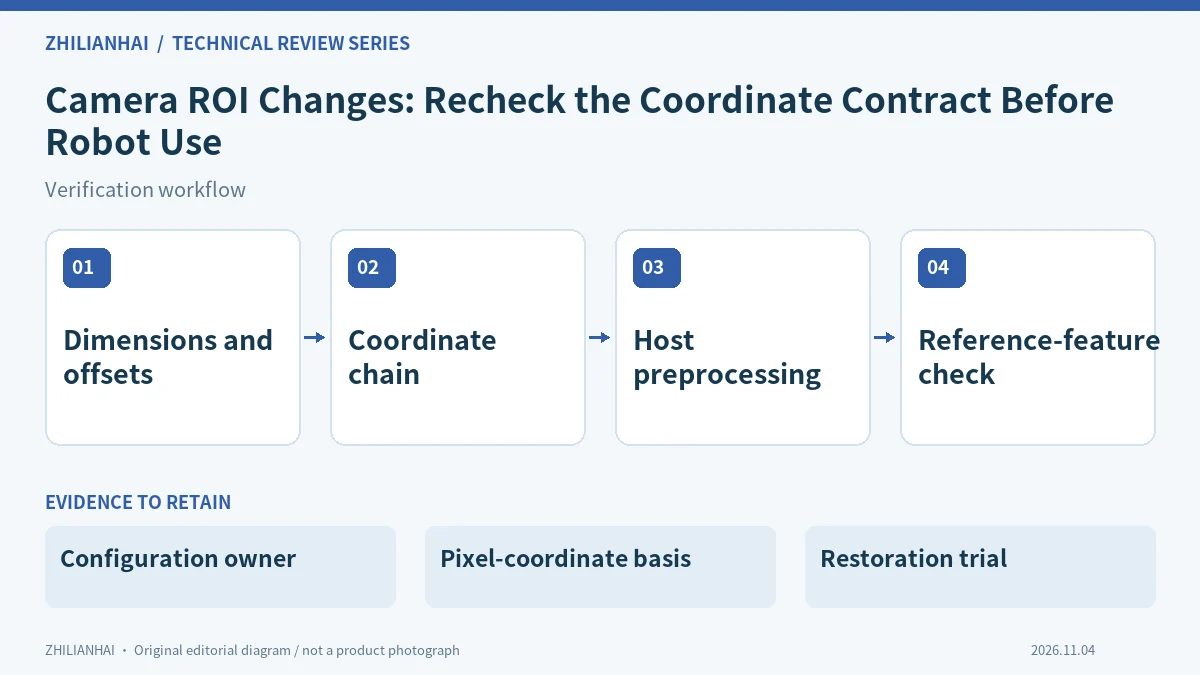
Save the complete geometry configuration
Keep width, height, offsets, pixel format and relevant binning settings in one record, with the previous baseline retained. A statement that the picture was cropped to a particular resolution is incomplete: identical dimensions can represent different sensor regions, while downstream software may depend on the location of that region.
Identify whether camera user sets, the acquisition application or a higher-level recipe owns the configuration. If several components can write it, document their startup order. Use settings read back for the actual acquisition as the evidence for the trial. A file saved before the application applies its own recipe may describe a configuration that never reaches normal operation.
Specify the coordinate basis at every boundary
Ask the integrator to state whether a reported position belongs to the cropped image, full sensor or another corrected coordinate system. Show the transformation chain. An offset must not be compensated twice, and a familiar variable name does not prove that a library has already applied the conversion.
Use reference features across the relevant field and compare transformed results with the accepted baseline. Decide the need for recalibration from the calibration model, transformation contract and observed errors. Changing an ROI does not establish one universal recalibration procedure for every installation. What matters is whether the delivered application can demonstrate the required geometry after the change.
Separate image cropping from automatic-control regions
The statistics region used by exposure or colour control is a different concept from the image region transmitted to the host. List them separately. After cropping, check whether the region driving automatic control still represents the intended scene instead of a changed background or an unrepresentative part of the workpiece.
When binning or decimation is also changed, consult the model-specific coordinate basis and permitted offsets. Retain final readback beside the actual images. A plausible group of numbers in a setup interface does not independently prove that the device accepted them, or that the receiving application interpreted their units in the same way as the camera.
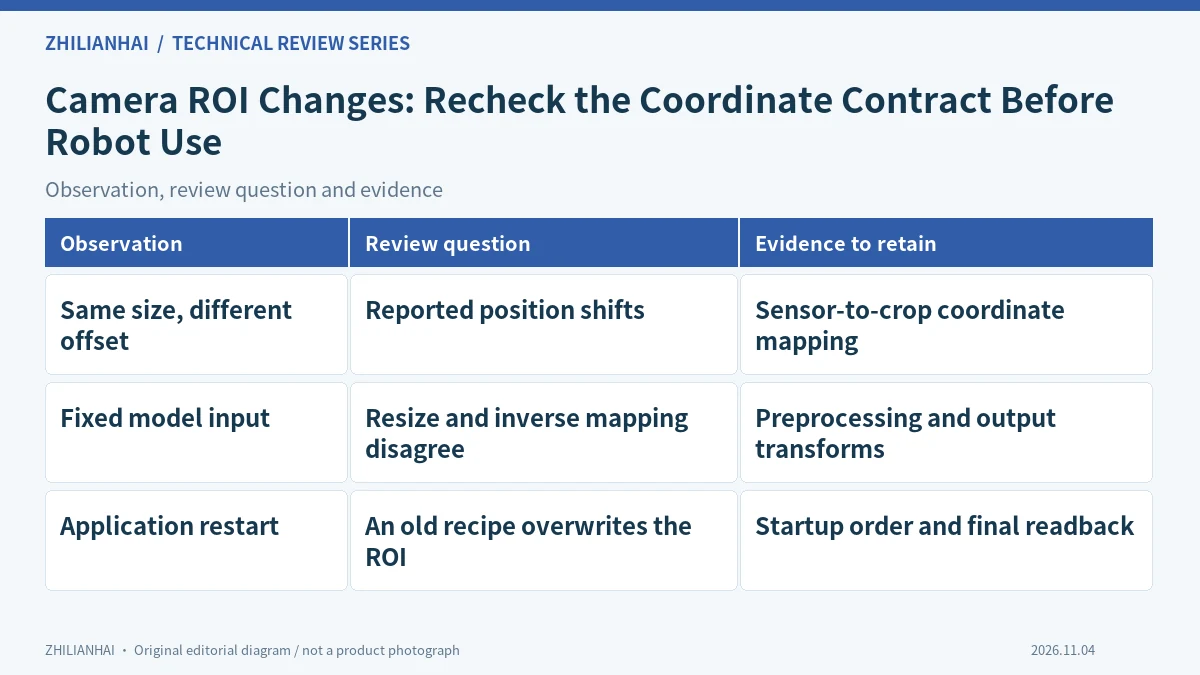
Review host-side assumptions about image size
A changed image can still encounter old assumptions in reception buffers, preprocessing crops, distortion maps, model inputs and overlay code. List the dimensions, stride or equivalent layout information expected at each stage and observe the actual input. Checking only the dimensions of a preview window leaves those hidden interfaces untested.
Use identifiable edge features to reveal truncation, padding and position shifts. A fixed-size inference path also needs documented resizing, padding and inverse-coordinate conversion. Successfully passing the picture into a model is not the same as mapping its output back correctly. The application must preserve that relationship before a robot uses the result for a positioning task.
Use restoration to test the completeness of the handover
Have the receiving team restore the original ROI and then reload the proposed ROI from the delivered records. Repeat the reference check for both states. This round trip can expose omitted host settings or an undocumented recipe override and shows whether maintainers know which component owns each configuration item.
Document the permitted adjustment range, approver and retest conditions. Report performance improvement separately from geometric validity. A higher frame rate can be a useful result, but pixel interpretation, coordinate conversion and the calibration relationship used for robot positioning still require their own evidence. Retaining both configurations makes that distinction maintainable after the original project team leaves.
Original documentation and further reading
Continue with related articles in this section, or use selection guides to prepare the next review. Apply the device-specific documentation and agreed operating conditions when implementing a test.