
Camera Binning: Revalidate Defect Visibility and Measurement Results
Basler describes binning as combining neighbouring pixel values by summation or averaging, with model-specific support. It can change noise, light response and spatial sampling together. A smaller image therefore needs a new inspection review, even when it looks cleaner.
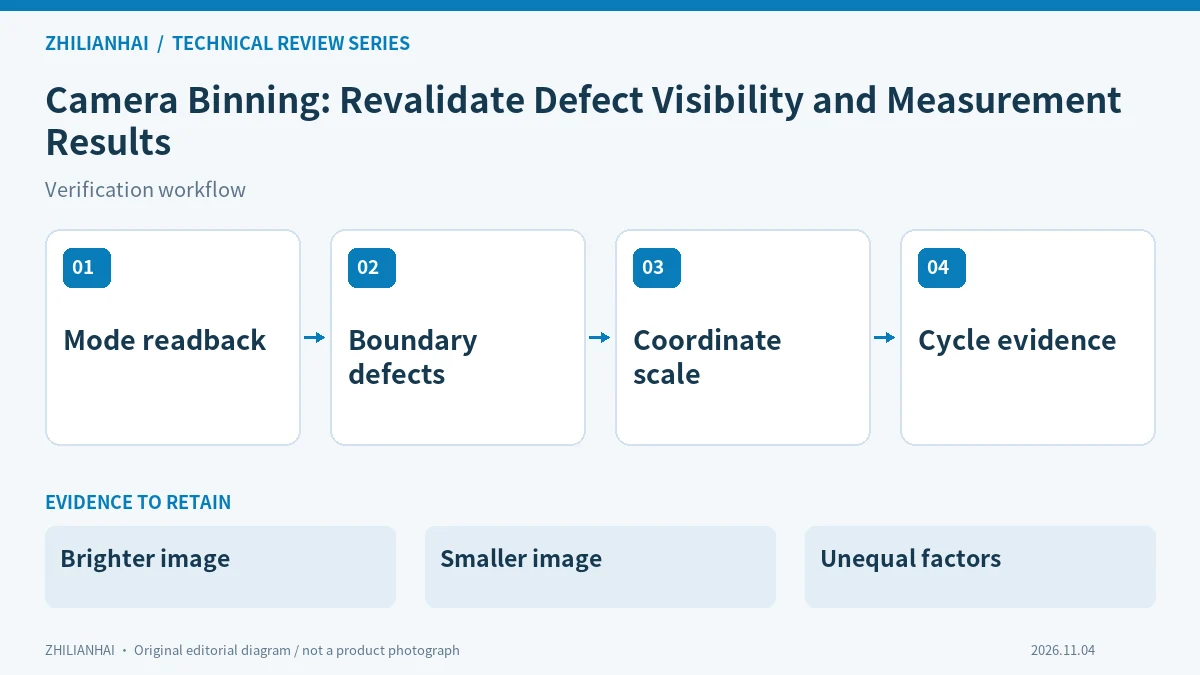
Separate summation from averaging
Summation can increase the light response, while averaging follows a different brightness relationship. Neither should be described merely as resizing. Read back horizontal and vertical modes, together with the supported sensor or processing selector, and attach those values to the acquired image.
For this review, identify the delivered device, software and configuration revisions first. Record unsupported, disabled and untested capabilities separately. Evidence from another model is useful context, but cannot establish what the delivered combination actually provides. Keep the original input beside the settings used to interpret it.
Compare the smallest relevant feature
Use a crack, gap or particle near the agreed decision boundary. Compare the same physical sample under the original and candidate settings. Record remaining feature width in pixels alongside the decision. A large outline can remain recognisable while a small defect disappears into the combined sample.
Retain the original input and the reason for the decision, rather than a successful screenshot alone. Change only the variables agreed for the comparison, and keep the before-and-after configuration. List conditions that were not exercised explicitly; they should not silently become part of the accepted operating range.
Explain both coordinate scales
Different horizontal and vertical factors can change apparent shape. Confirm how measurement software interprets each direction and whether the viewer stretches the image for display. Keep acquired pixels separately from rendered screenshots so that an attractive display cannot conceal an incorrect coordinate conversion.
Use the three illustrated observations as starting questions, rather than as diagnoses of an installation that has not been inspected. Check record completeness, units and identity before selecting the next observation. An unresolved result is more informative than a confident explanation assembled from missing fields or unrelated test runs.
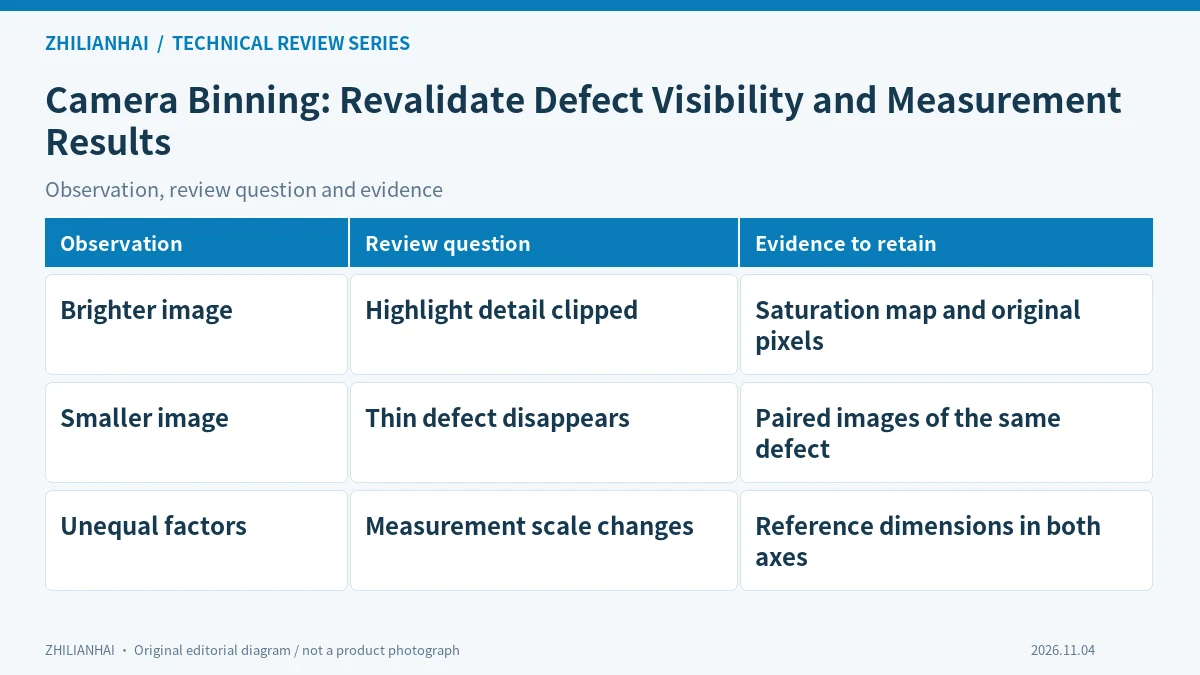
Check saturation before retuning thresholds
An increased signal can also clip highlights. Inspect saturated regions before adjusting an inspection threshold. Avoid changing exposure, gain and binning simultaneously simply to restore average brightness: that experiment would not show which change affected defect contrast or the false-reject boundary.
Let the site owner choose an approved isolated way to exercise relevant exceptions. Record normal operation, the exceptional condition and recovery separately. The purpose is to establish how the application recognises and explains untrustworthy input, without requiring production equipment to act on deliberately invalid results.
Measure the actual application benefit
A smaller payload does not imply a proportional improvement in the complete inspection cycle. Measure acquisition intervals, transport load and decision completion separately. State which geometry and defect tests must be repeated when the binning configuration changes; preserve the unmodified reference images for that review.
Deliver the configuration, representative samples, result table and unresolved questions together. Agree who reviews subsequent changes. The receiving team should be able to select one conclusion and trace it back to its input and decision path without relying on the original author to reconstruct the missing steps.
Original documentation and further reading
Continue with related articles in this section, or use selection guides to prepare the next review. Apply the device-specific documentation and agreed operating conditions when implementing a test.