
Camera Decimation: Test Thin Features Before Accepting Faster Images
Basler decimation transmits selected rows or columns rather than combining all neighbouring samples. Monochrome and colour sampling arrangements differ, and horizontal and vertical changes do not have identical frame-rate effects. Review retained information and speed as separate outcomes.
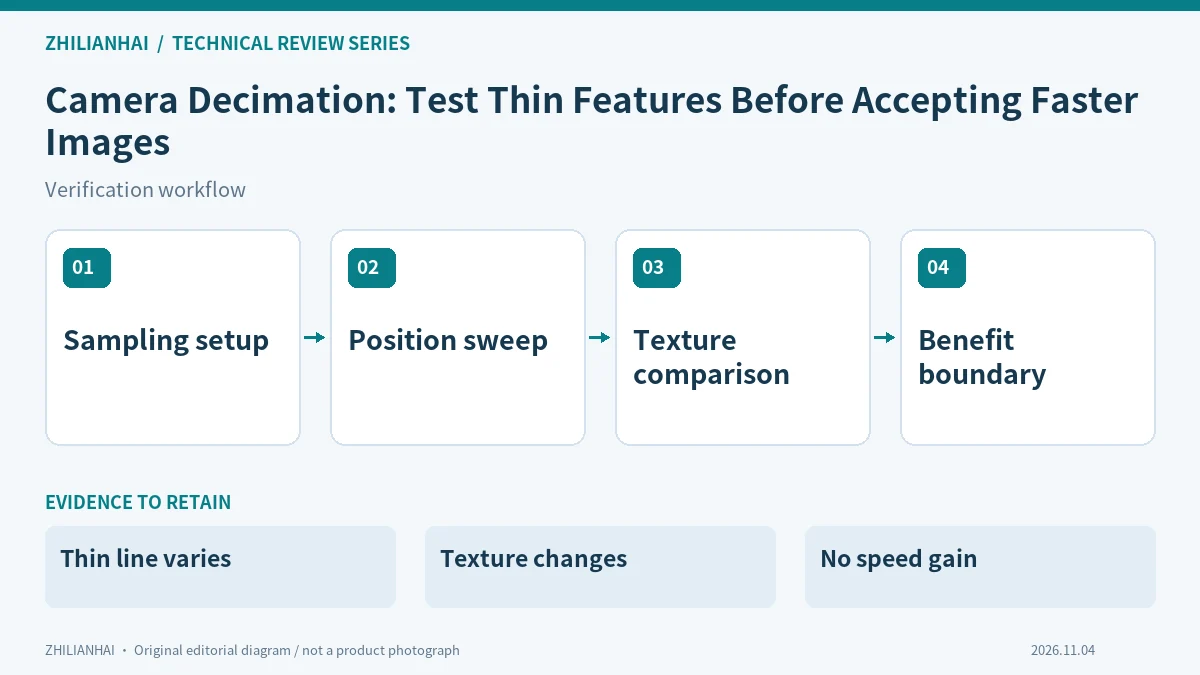
Identify the sampling operation
Record horizontal and vertical factors, output dimensions and pixel format. Colour-camera sampling can use row or column pairs, so a monochrome example is not automatically the correct interpretation. A viewer zoom setting also provides no evidence of the acquisition configuration.
For this review, identify the delivered device, software and configuration revisions first. Record unsupported, disabled and untested capabilities separately. Evidence from another model is useful context, but cannot establish what the delivered combination actually provides. Keep the original input beside the settings used to interpret it.
Move the same thin feature
Compare a thin line or edge at several nearby positions and orientations. A feature can appear stable at one sampling phase and weaken at another. Use the same physical reference, rather than selecting a different, easier sample for each candidate setting.
Retain the original input and the reason for the decision, rather than a successful screenshot alone. Change only the variables agreed for the comparison, and keep the before-and-after configuration. List conditions that were not exercised explicitly; they should not silently become part of the accepted operating range.
Inspect repeated textures separately
Mesh, dense stripes and other repeated structures can produce misleading patterns after subsampling. Compare original and candidate pixels to determine whether an apparent defect comes from the object or from the sampling relationship. Include acceptable texture variation as well as defective samples.
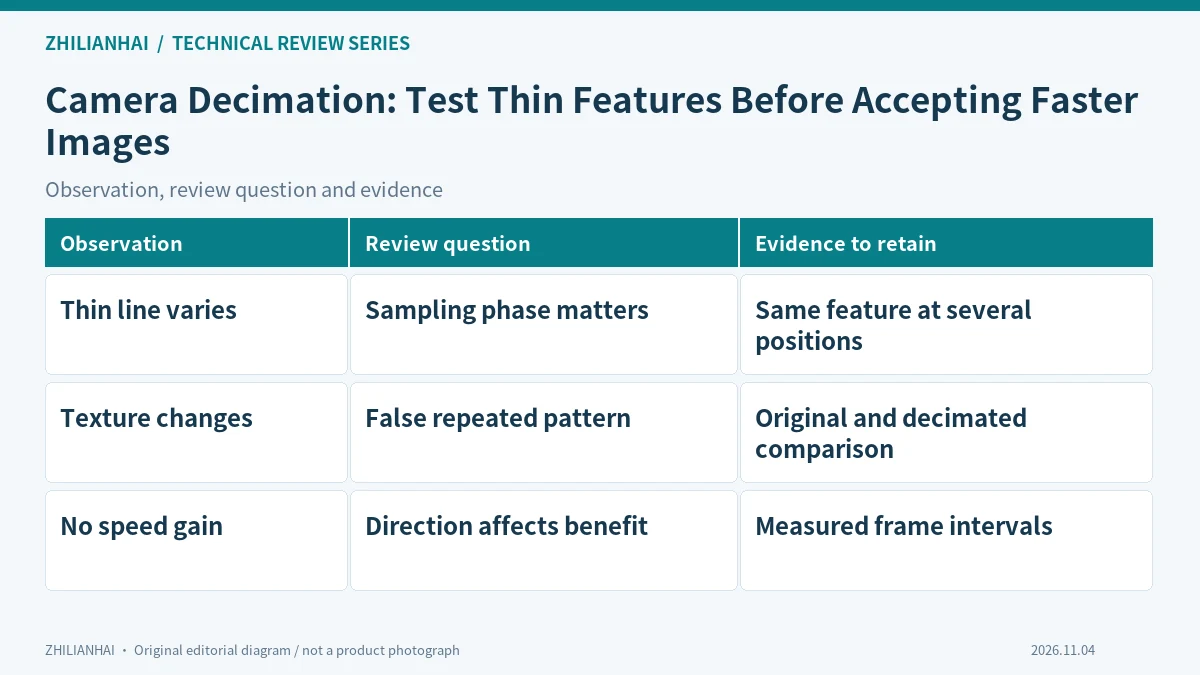
Use the three illustrated observations as starting questions, rather than as diagnoses of an installation that has not been inspected. Check record completeness, units and identity before selecting the next observation. An unresolved result is more informative than a confident explanation assembled from missing fields or unrelated test runs.
Verify the final feature combination
Basler documents restrictions involving scaling and binning in the same direction. Read back the final configuration after application startup. A rejected parameter write or an automatically adjusted image region must be visible in the record, rather than silently treated as the requested setting.
Let the site owner choose an approved isolated way to exercise relevant exceptions. Record normal operation, the exceptional condition and recovery separately. The purpose is to establish how the application recognises and explains untrustworthy input, without requiring production equipment to act on deliberately invalid results.
Report direction-specific trade-offs
Measure frame intervals, payload and feature decisions for each relevant direction. Do not infer a fixed speed multiplier from reduced pixel count. The recommendation should identify both the useful operating range and the detail that the candidate configuration no longer preserves.
Deliver the configuration, representative samples, result table and unresolved questions together. Agree who reviews subsequent changes. The receiving team should be able to select one conclusion and trace it back to its input and decision path without relying on the original author to reconstruct the missing steps.
Original documentation and further reading
Continue with related articles in this section, or use selection guides to prepare the next review. Apply the device-specific documentation and agreed operating conditions when implementing a test.