
OpenVINO Latency: Measure the Complete Camera-to-Decision Path
OpenVINO latency guidance discusses concurrent requests, device contention and first-inference overhead, and recommends performance hints for configuration. This review makes no device-speed promise. It establishes measurements that explain how long the actual application waits for a usable result.
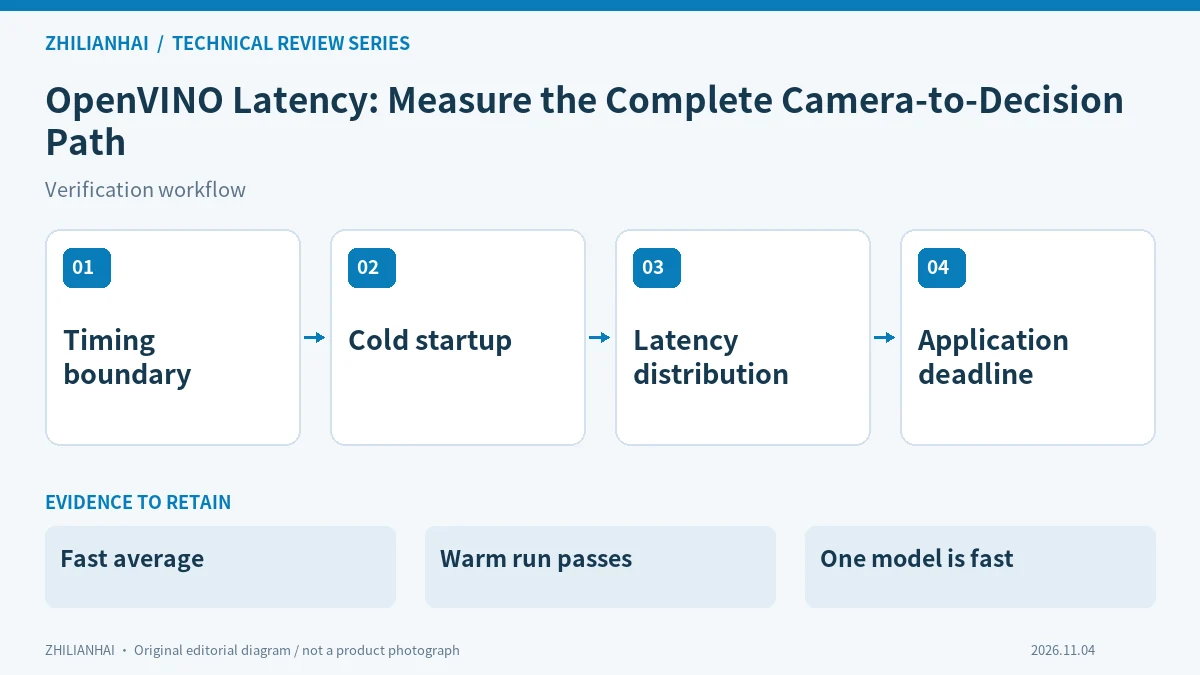
Define result availability
Separate model execution, preprocessing, input waiting and result publication, with a clock source for each boundary. Establish which deadline the robot application needs. A measurement covering device computation alone does not represent the complete interval from image acquisition to an actionable decision.
For this review, identify the delivered device, software and configuration revisions first. Record unsupported, disabled and untested capabilities separately. Evidence from another model is useful context, but cannot establish what the delivered combination actually provides. Keep the original input beside the settings used to interpret it.
Report cold startup separately
Record loading, compilation, first execution and subsequent requests, and state whether the model remains resident. Restart recovery and on-demand loading depend on the first usable result. A warmed-up best case does not establish how soon the application becomes useful after a restart.
Retain the original input and the reason for the decision, rather than a successful screenshot alone. Change only the variables agreed for the comparison, and keep the before-and-after configuration. List conditions that were not exercised explicitly; they should not silently become part of the accepted operating range.
Keep distributions and input identity
Retain input identity and timing for individual requests, including slower cases. An average conceals occasional long waits and cannot show whether they cluster around particular inputs or shapes. Preserve enough samples to explain the distribution rather than presenting only the fastest completed request.
Use the three illustrated observations as starting questions, rather than as diagnoses of an installation that has not been inspected. Check record completeness, units and identity before selecting the next observation. An unresolved result is more informative than a confident explanation assembled from missing fields or unrelated test runs.
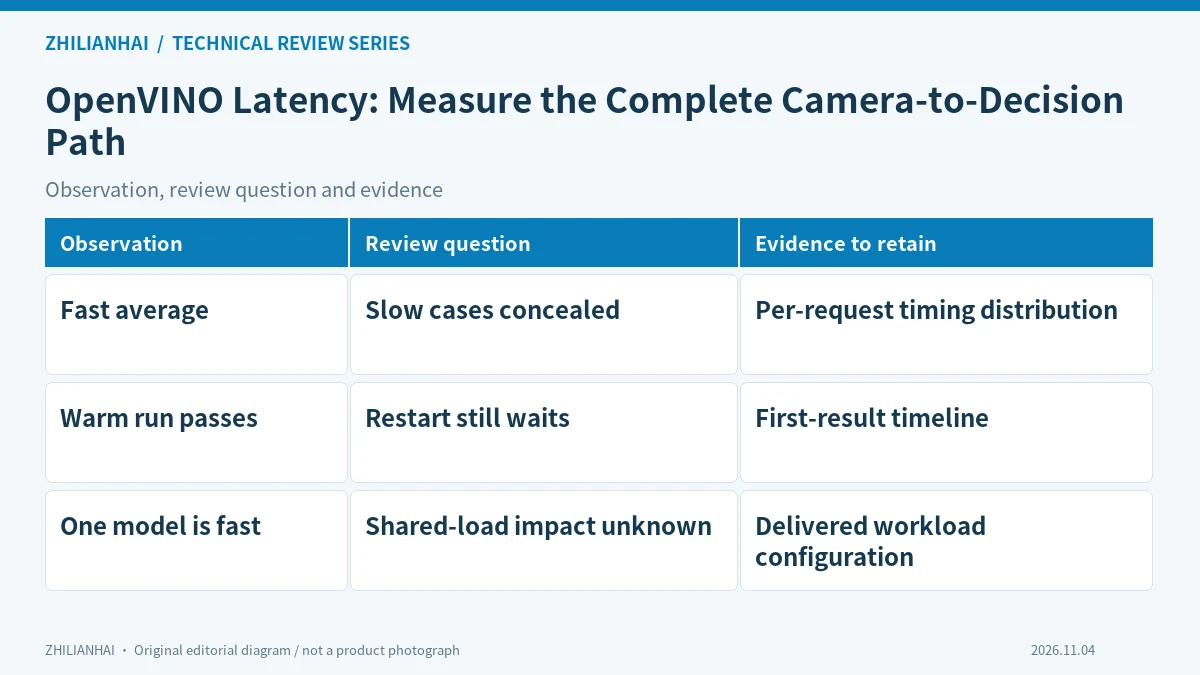
Observe competing workloads
Review other models, image conversion and system work in the delivered software combination. State which loads were present during measurement. An idle-device result cannot automatically be applied to a production arrangement where inference shares compute and memory resources with other active tasks.
Let the site owner choose an approved isolated way to exercise relevant exceptions. Record normal operation, the exceptional condition and recovery separately. The purpose is to establish how the application recognises and explains untrustworthy input, without requiring production equipment to act on deliberately invalid results.
Deliver a deadline-to-configuration record
Keep performance hints, device, model and software revisions beside the samples supporting each deadline conclusion. Recheck output correctness after optimisation. Improved timing is a separate result from detection quality and exception handling, and should not replace either of those acceptance requirements.
Deliver the configuration, representative samples, result table and unresolved questions together. Agree who reviews subsequent changes. The receiving team should be able to select one conclusion and trace it back to its input and decision path without relying on the original author to reconstruct the missing steps.
Original documentation and further reading
Continue with related articles in this section, or use selection guides to prepare the next review. Apply the device-specific documentation and agreed operating conditions when implementing a test.