
OpenVINO Model Caching: Separate Cold Starts From Warm Restarts
OpenVINO model caching can reuse exported compiled models to reduce repeated compilation on supported devices. Import and export support is not universal. A cache directory or a successful file write alone does not establish the expected application-startup benefit.
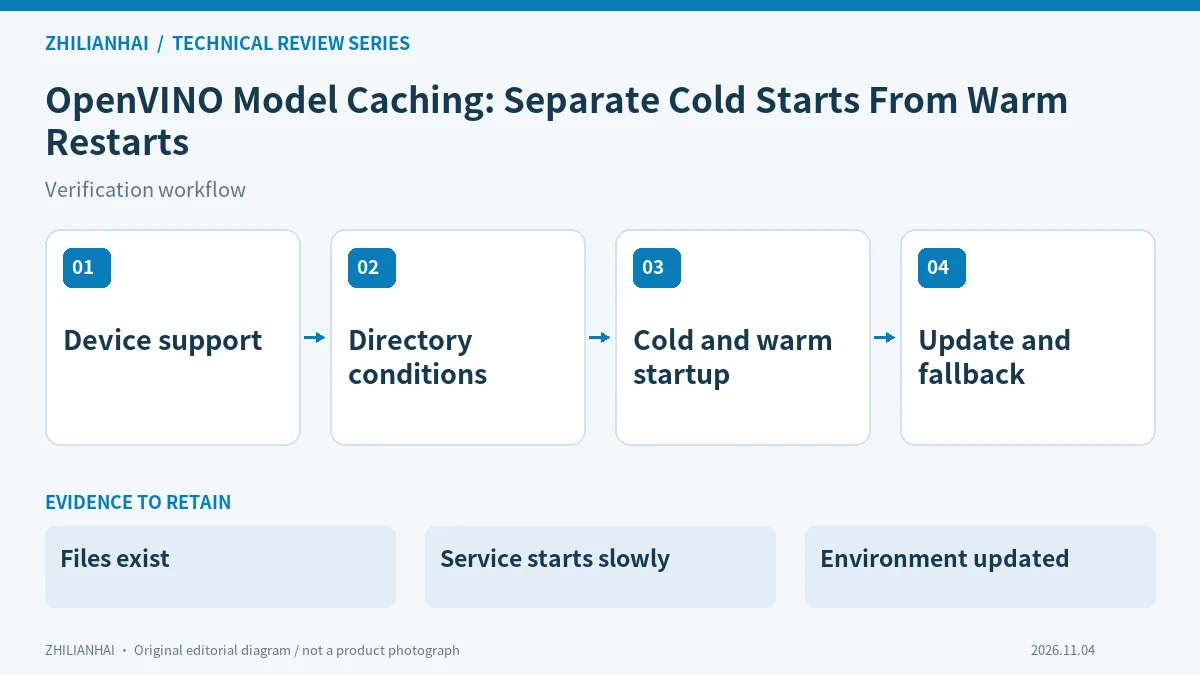
Establish actual support
Record device, plugin, model and runtime revisions and check cache support for that combination. Distinguish unsupported operation, unreadable storage and an ordinary miss. An empty directory alone does not establish a model or device fault, and a populated directory does not establish successful reuse.
For this review, identify the delivered device, software and configuration revisions first. Record unsupported, disabled and untested capabilities separately. Evidence from another model is useful context, but cannot establish what the delivered combination actually provides. Keep the original input beside the settings used to interpret it.
Compare cold and reusable-cache startup
Retain timelines for no usable cache and an existing matching cache. Separate loading, compilation and first valid result. Changes in steady-state inference time should not be attributed to cache presence without another explanation; startup reuse and repeated execution are different measurement boundaries.
Retain the original input and the reason for the decision, rather than a successful screenshot alone. Change only the variables agreed for the comparison, and keep the before-and-after configuration. List conditions that were not exercised explicitly; they should not silently become part of the accepted operating range.
Check the running account and storage
Verify directory access using the actual service account, with path, capacity and cleanup rules. An interactive user ability to write does not establish service access. Explain the normal fallback after temporary storage is cleaned so that a later cold start is not mistaken for unexplained regression.
Use the three illustrated observations as starting questions, rather than as diagnoses of an installation that has not been inspected. Check record completeness, units and identity before selecting the next observation. An unresolved result is more informative than a confident explanation assembled from missing fields or unrelated test runs.
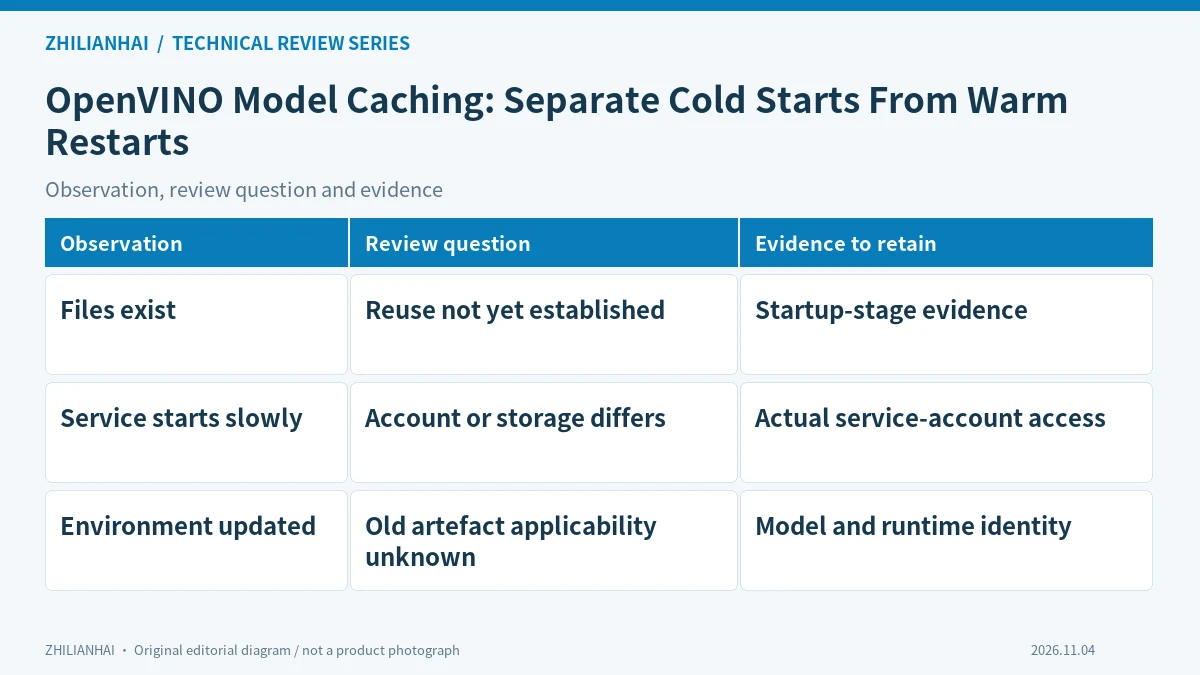
Review changes with provenance
Associate cached artefacts with model and configuration identity and observe behaviour after runtime, device or model changes. Do not assume an unknown copied cache is compatible. Cache reuse is a startup observation, not a replacement for version provenance or output-correctness validation.
Let the site owner choose an approved isolated way to exercise relevant exceptions. Record normal operation, the exceptional condition and recovery separately. The purpose is to establish how the application recognises and explains untrustworthy input, without requiring production equipment to act on deliberately invalid results.
Deliver a recoverable startup baseline
Document cache use, directory ownership and representative startup records, including expected operation without a cache. End the recovery measurement at the first usable result. State any dependency on pre-existing artefacts so that device replacement does not inherit an undisclosed timing assumption.
Deliver the configuration, representative samples, result table and unresolved questions together. Agree who reviews subsequent changes. The receiving team should be able to select one conclusion and trace it back to its input and decision path without relying on the original author to reconstruct the missing steps.
Original documentation and further reading
Continue with related articles in this section, or use selection guides to prepare the next review. Apply the device-specific documentation and agreed operating conditions when implementing a test.