
OpenVINO Dynamic Shapes: Test the Supported Size Range and Transition Cost
OpenVINO dynamic shapes address dimensions unknown at compilation, with performance and memory effects that should be measured on real data. Repeated reshaping and recompilation is a different implementation. Establish which path the delivered application actually uses.
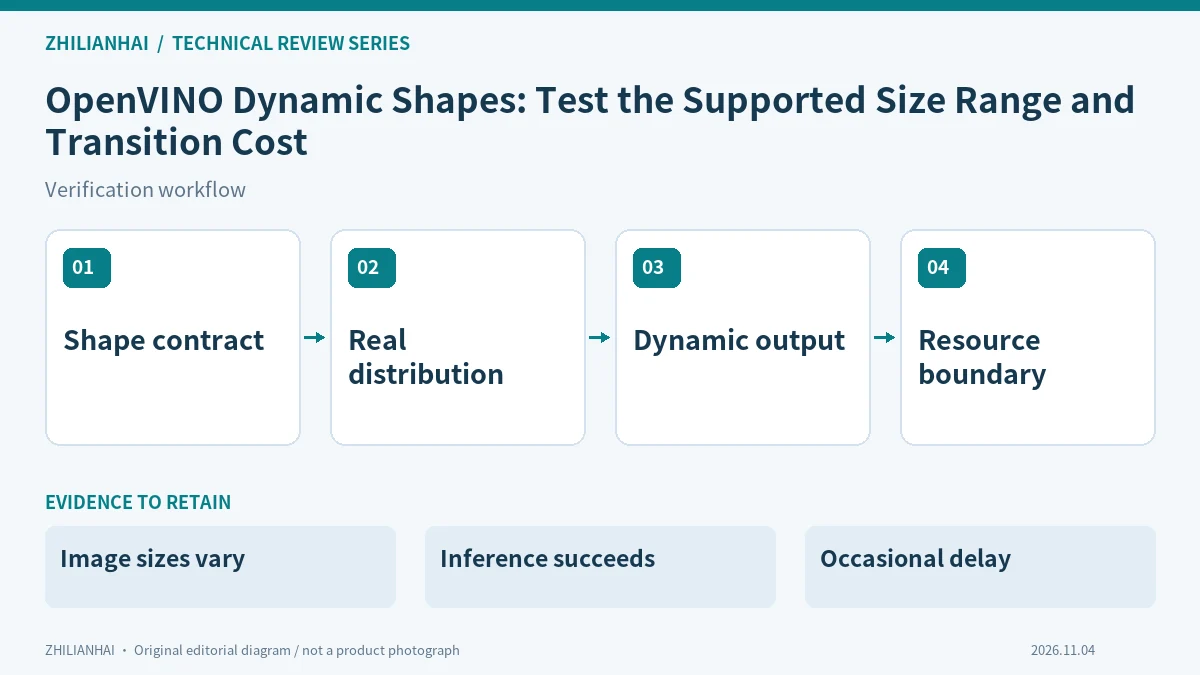
Identify the changing dimensions
State whether batch, spatial size or another axis varies and retain the model interface contract. Source-image dimensions need not equal tensor dimensions: preprocessing may resize or pad. Record the shape actually submitted rather than inferring dynamic behaviour from the size of an input file.
For this review, identify the delivered device, software and configuration revisions first. Record unsupported, disabled and untested capabilities separately. Evidence from another model is useful context, but cannot establish what the delivered combination actually provides. Keep the original input beside the settings used to interpret it.
Sample the real shape distribution
Include common, smaller, larger and alternating shapes with per-case timing. A favourable single shape is incomplete evidence. Observe the first occurrence and repeated occurrences separately so that the report can explain shape-related initial work instead of hiding it in a warmed-up average.
Retain the original input and the reason for the decision, rather than a successful screenshot alone. Change only the variables agreed for the comparison, and keep the before-and-after configuration. List conditions that were not exercised explicitly; they should not silently become part of the accepted operating range.
Review output interpretation
Read actual output shapes rather than assuming a fixed host container. Cover empty results, varying detection counts and coordinate conversion back to the source image. Successful inference alone does not prove that postprocessing avoids truncation or interprets a dynamically sized output correctly.
Use the three illustrated observations as starting questions, rather than as diagnoses of an installation that has not been inspected. Check record completeness, units and identity before selecting the next observation. An unresolved result is more informative than a confident explanation assembled from missing fields or unrelated test runs.
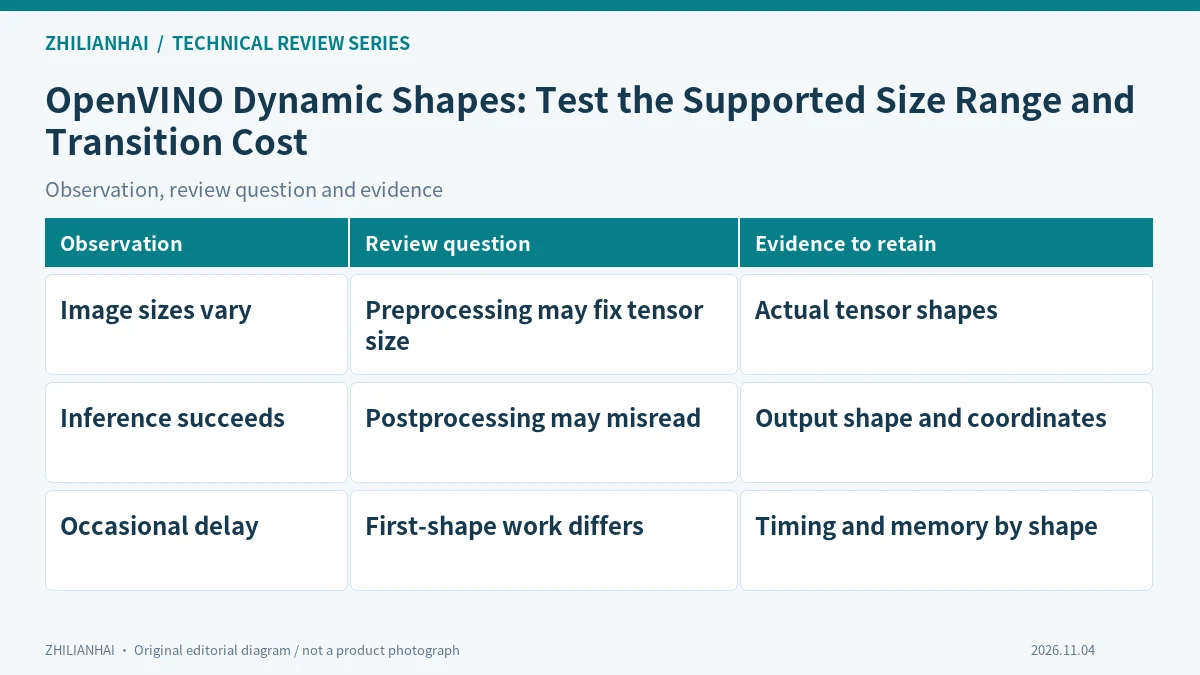
Observe switching under concurrency
Alternate shapes under the delivered concurrency policy and review memory, queueing and failure handling. Hardware plugins can differ. Results from a development machine do not establish identical shape support or resource behaviour on another target device, even when both run the same model file.
Let the site owner choose an approved isolated way to exercise relevant exceptions. Record normal operation, the exceptional condition and recovery separately. The purpose is to establish how the application recognises and explains untrustworthy input, without requiring production equipment to act on deliberately invalid results.
Deliver the verified shape range
List exercised shapes, untested ranges and the response to inputs outside the contract. Review affected dimensions after preprocessing, model or plugin changes. Retain a replayable input list rather than a broad dynamic-support statement that does not identify the conditions actually checked.
Deliver the configuration, representative samples, result table and unresolved questions together. Agree who reviews subsequent changes. The receiving team should be able to select one conclusion and trace it back to its input and decision path without relying on the original author to reconstruct the missing steps.
Original documentation and further reading
Continue with related articles in this section, or use selection guides to prepare the next review. Apply the device-specific documentation and agreed operating conditions when implementing a test.