
Topic Periods: Find Uneven Updates Behind a Healthy Average
Inspect inter-arrival periods, variation and raw samples so a healthy average does not hide uneven robot sensor or control-topic updates. This guide concerns robot integration and delivery review. The proposed observations are editorial assessment guidance, grounded in the linked original documentation and subject to the deployed version. They do not describe an on-site test of a particular machine or establish whole-system acceptance from a single interface response.
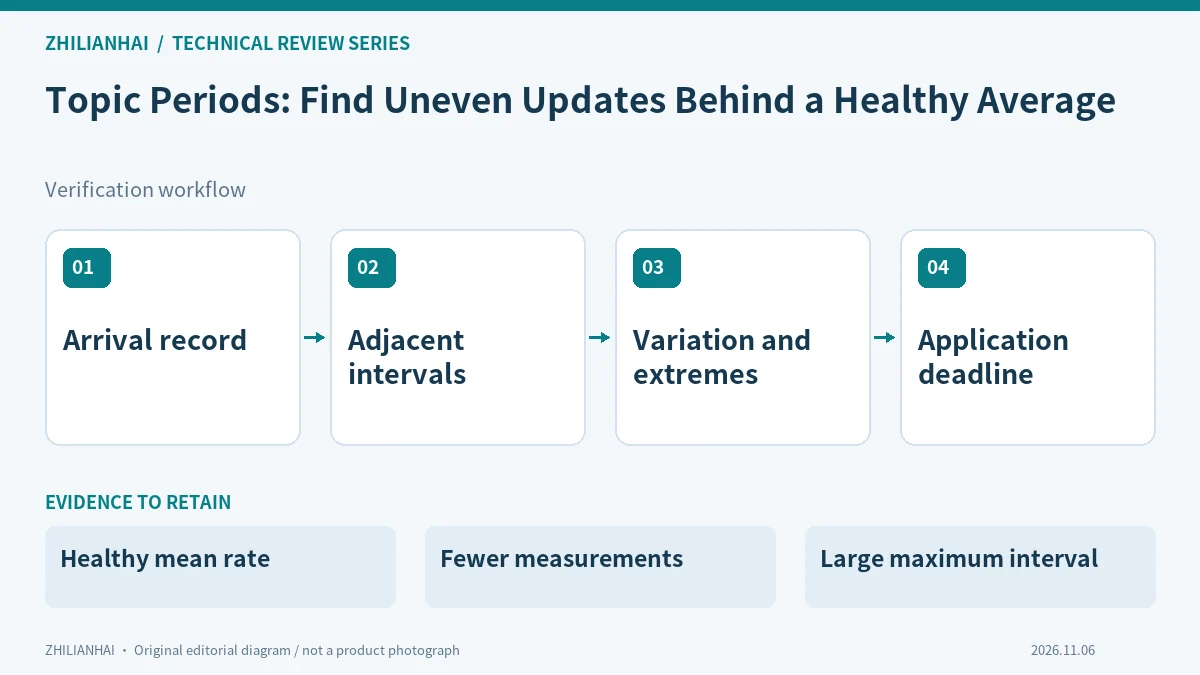
Distinguish rate from intervals
Identify whether the application needs average throughput or a bound on waiting. A burst followed by a pause can produce an apparently healthy average rate. Build the sequence of intervals between successive arrivals before discussing mean, extremes and variation. A single frequency should not answer every question about the timing of individual updates.
For this review, identify the delivered device, software and configuration revisions first. Record unsupported, disabled and untested capabilities separately. Evidence from another model is useful context, but cannot establish what the delivered combination actually provides. Keep the original input beside the settings used to interpret it.
Explain the initial sample
Period measurement requires a preceding arrival. At startup or an observation boundary, one arrival alone does not establish an interval. Keep subscription startup and the first valid arrival pair, explaining why a measurement count can differ from a received-message count. Do not invent a nominal initial interval simply to make the totals match.
Retain the original input and the reason for the decision, rather than a successful screenshot alone. Change only the variables agreed for the comparison, and keep the before-and-after configuration. List conditions that were not exercised explicitly; they should not silently become part of the accepted operating range.
Join extremes to arrivals
When a maximum interval greatly exceeds the mean, inspect the associated arrivals before choosing an explanation. Bursty publication or receiver scheduling may contribute. An aggregate extreme establishes uneven observed spacing, without establishing packet loss. Missing-message claims require identity, sequence information or an appropriate record from another boundary.
Use the three illustrated observations as starting questions, rather than as diagnoses of an installation that has not been inspected. Check record completeness, units and identity before selecting the next observation. An unresolved result is more informative than a confident explanation assembled from missing fields or unrelated test runs.
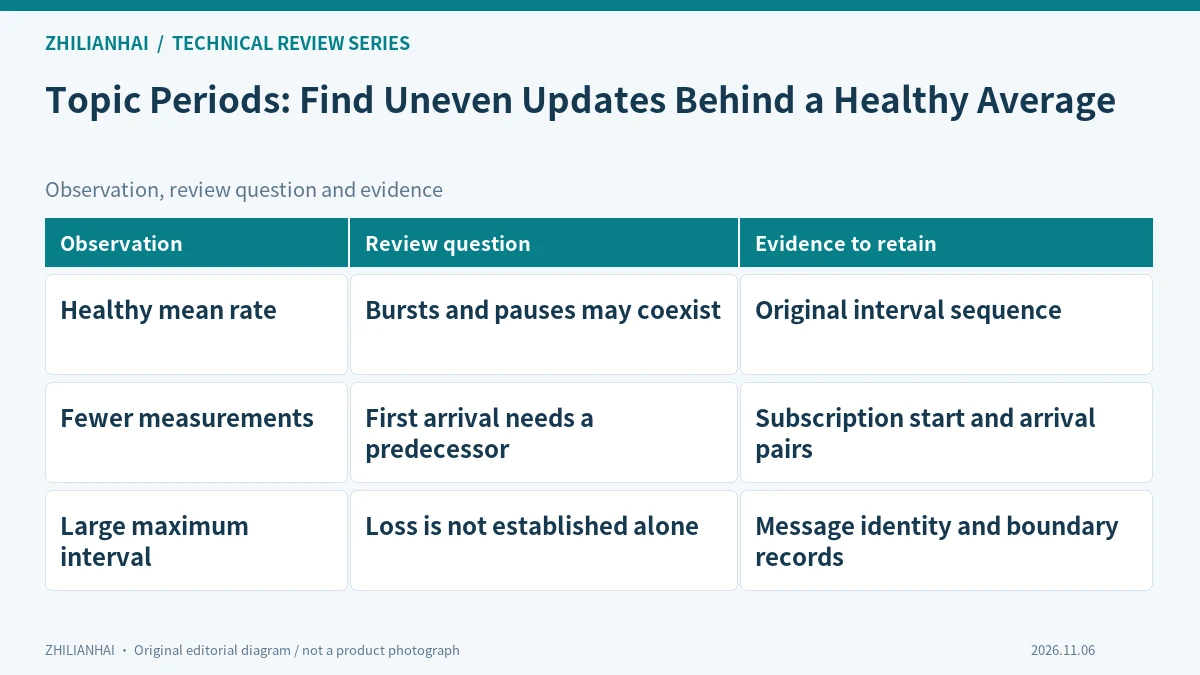
Keep application deadlines explicit
Document the consumer’s freshness requirement and timeout response separately from the statistic’s collection settings. Record how the application treats late arrivals, bursts and older samples after recovery. Statistics describe observations; application acceptance still depends on the agreed deadline, input conditions and resulting consumer behaviour, rather than on the monitoring default.
Let the site owner choose an approved isolated way to exercise relevant exceptions. Record normal operation, the exceptional condition and recovery separately. The purpose is to establish how the application recognises and explains untrustworthy input, without requiring production equipment to act on deliberately invalid results.
Compare equivalent workloads
Include message size, producer cadence, subscriber load and window settings in comparisons. Otherwise, mean values from different operating conditions can be mistaken for device rankings. Retain enough original intervals to revisit unusual windows. If only an aggregate mean survives, identify that individual pauses can no longer be reconstructed from that value.
Deliver the configuration, representative samples, result table and unresolved questions together. Agree who reviews subsequent changes. The receiving team should be able to select one conclusion and trace it back to its input and decision path without relying on the original author to reconstruct the missing steps.
Original documentation and further reading
Continue with related articles in this section, or use selection guides to prepare the next review. Apply the device-specific documentation and agreed operating conditions when implementing a test.