
Topic Statistics: Check Coverage and Observation Cost
Review subscription coverage, unsupported metrics and enabled-versus-disabled workload evidence before adopting robot topic statistics. This guide concerns robot integration and delivery review. The proposed observations are editorial assessment guidance, grounded in the linked original documentation and subject to the deployed version. They do not describe an on-site test of a particular machine or establish whole-system acceptance from a single interface response.
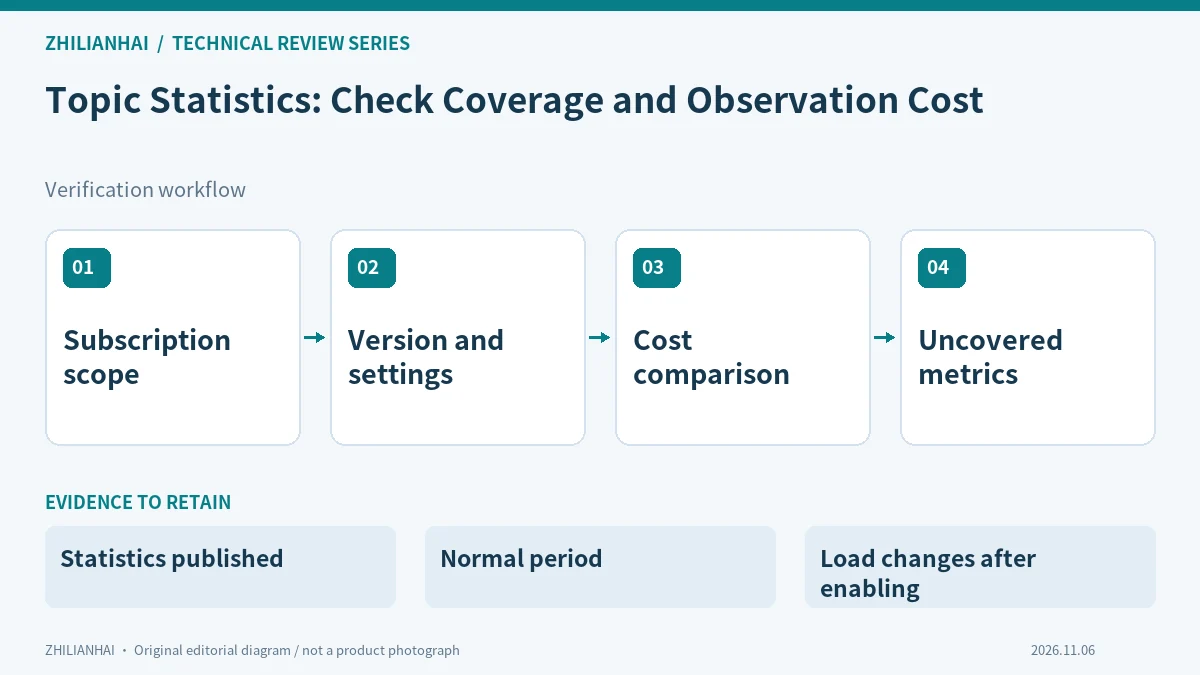
List the observed subscriptions
Record the node, topic, subscription and client-library revision where statistics are enabled. A subscription-side observation describes that receiving path rather than every consumer or the whole network. For several subscribers on one topic, identify their workloads and settings individually before extending a result beyond the endpoint that produced it.
For this review, identify the delivered device, software and configuration revisions first. Record unsupported, disabled and untested capabilities separately. Evidence from another model is useful context, but cannot establish what the delivered combination actually provides. Keep the original input beside the settings used to interpret it.
Verify implementation support
Confirm support using the deployed API and actual output, retaining enablement settings, output location and window. An example for one client language does not establish identical interfaces elsewhere. If a framework hides subscription creation, retain evidence of the actual enabled configuration rather than relying on the label of a monitoring switch.
Retain the original input and the reason for the decision, rather than a successful screenshot alone. Change only the variables agreed for the comparison, and keep the before-and-after configuration. List conditions that were not exercised explicitly; they should not silently become part of the accepted operating range.
Identify metrics not measured
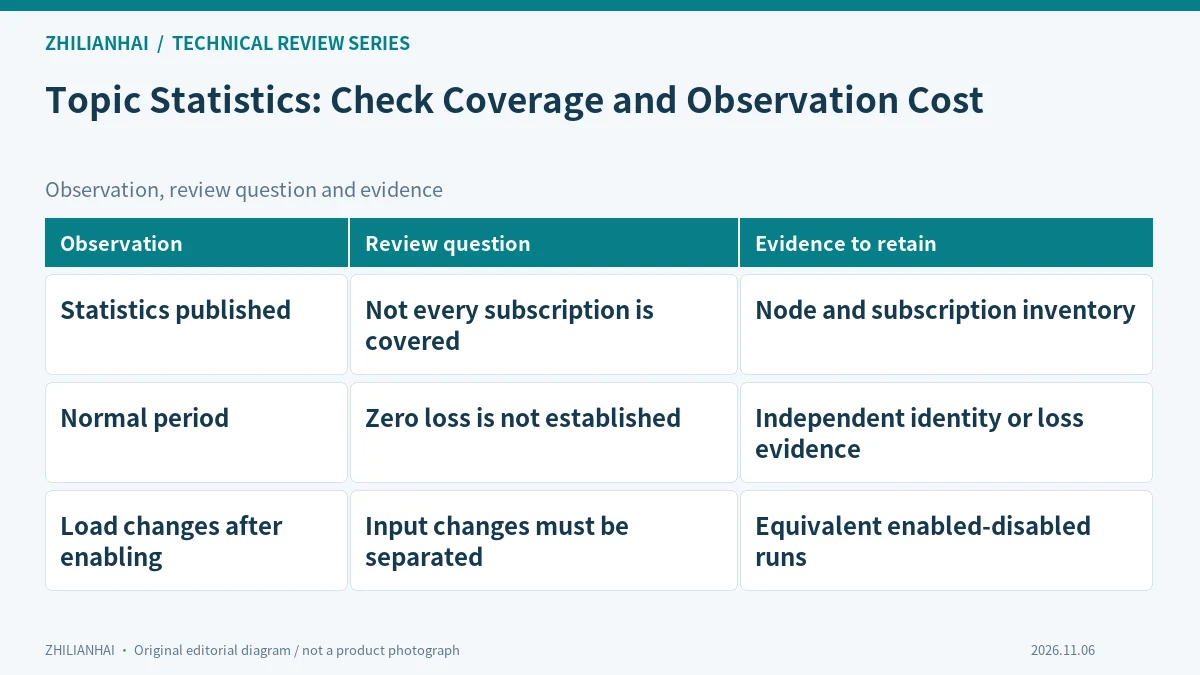
The referenced feature does not supply every desired metric, including dropped-message counts or traffic volume. A normal period does not establish zero loss, and age does not establish bandwidth use. Map each requested operational metric to an actual data source, leaving unsupported claims unresolved rather than constructing an apparently complete dashboard from unsuitable substitutes.
Use the three illustrated observations as starting questions, rather than as diagnoses of an installation that has not been inspected. Check record completeness, units and identity before selecting the next observation. An unresolved result is more informative than a confident explanation assembled from missing fields or unrelated test runs.
Compare enabled and disabled operation
Observe processing, publication and resource behaviour with statistics enabled and disabled under comparable inputs. Include steady operation and expected workload changes. Differences across unrelated workloads cannot be assigned entirely to monitoring. Document the additional reporting path and measure its effect before calling its cost negligible for the delivered installation.
Let the site owner choose an approved isolated way to exercise relevant exceptions. Record normal operation, the exceptional condition and recovery separately. The purpose is to establish how the application recognises and explains untrustworthy input, without requiring production equipment to act on deliberately invalid results.
Deliver a coverage map
Deliver observed endpoints, retention method, enablement comparison and unsupported metrics, with responsibility for reviewing configuration changes. Include report frequency and storage assumptions. A maintainer can then distinguish the receiving paths supported by normal statistics from paths that still require publisher records, tracing or application-level message identity to answer the operational question.
Deliver the configuration, representative samples, result table and unresolved questions together. Agree who reviews subsequent changes. The receiving team should be able to select one conclusion and trace it back to its input and decision path without relying on the original author to reconstruct the missing steps.
Original documentation and further reading
Continue with related articles in this section, or use selection guides to prepare the next review. Apply the device-specific documentation and agreed operating conditions when implementing a test.