
Robot Security Enclaves: Review Process Identity Boundaries
Map robot processes and maintenance tools to their selected security enclaves, retaining launch evidence instead of inferring identity from node names. This guide concerns robot integration and delivery review. The proposed observations are editorial assessment guidance, grounded in the linked original documentation and subject to the deployed version. They do not describe an on-site test of a particular machine or establish whole-system acceptance from a single interface response.
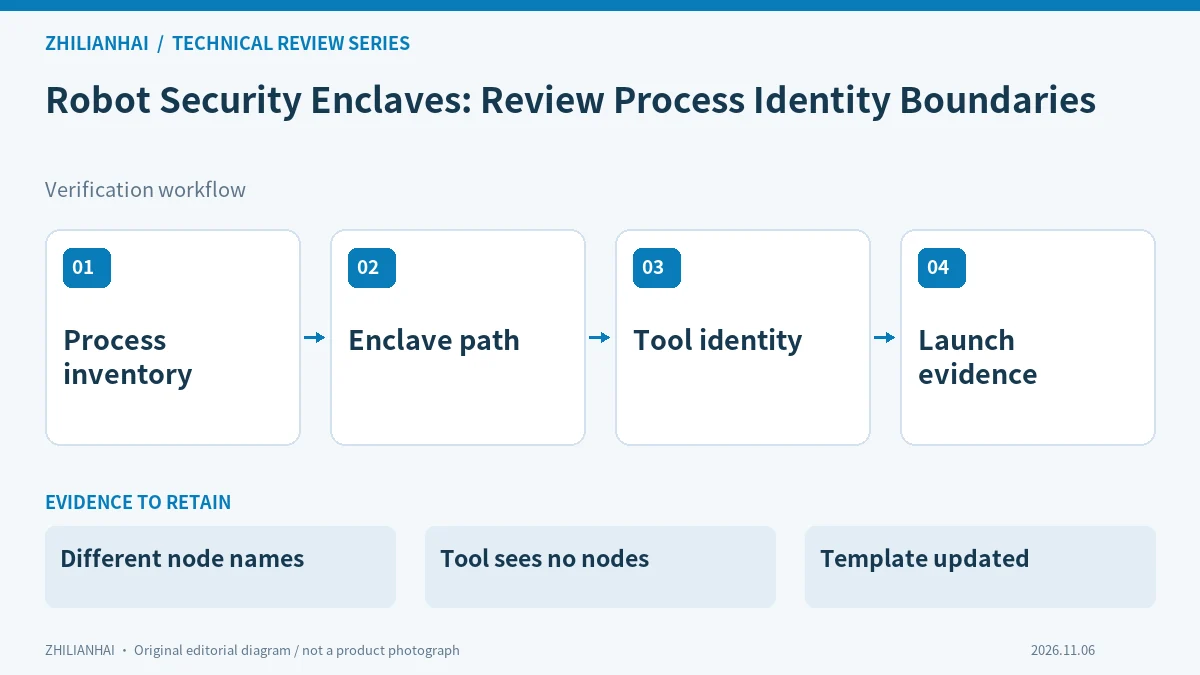
Start from the process inventory
List operating processes, hosted nodes and intended enclave paths. A node name identifies a graph object rather than proving the selected security identity. For components sharing a process, document how the security configuration applies to that arrangement. Separate nodes in a graph view should not be presented as proof of independently isolated runtime identities.
For this review, identify the delivered device, software and configuration revisions first. Record unsupported, disabled and untested capabilities separately. Evidence from another model is useful context, but cannot establish what the delivered combination actually provides. Keep the original input beside the settings used to interpret it.
Inspect the launcher’s selected path
Retain effective launch arguments, environment source and keystore reference with the deployment revision. A developer’s successful manual launch does not establish equivalent production-launcher settings. For reused templates, inspect expanded values and actual process evidence so that an unintended shared directory is not mistaken for the planned separation between process identities.
Retain the original input and the reason for the decision, rather than a successful screenshot alone. Change only the variables agreed for the comparison, and keep the before-and-after configuration. List conditions that were not exercised explicitly; they should not silently become part of the accepted operating range.
Review maintenance-tool identity separately
The tutorial describes an enclave override for command-line tools and cautions that the daemon may lack suitable enclave configuration. If a tool cannot see nodes, inspect its own identity and discovery observation period. Removing security merely to populate a list would change the tested arrangement rather than validate the original deployment.
Use the three illustrated observations as starting questions, rather than as diagnoses of an installation that has not been inspected. Check record completeness, units and identity before selecting the next observation. An unresolved result is more informative than a confident explanation assembled from missing fields or unrelated test runs.
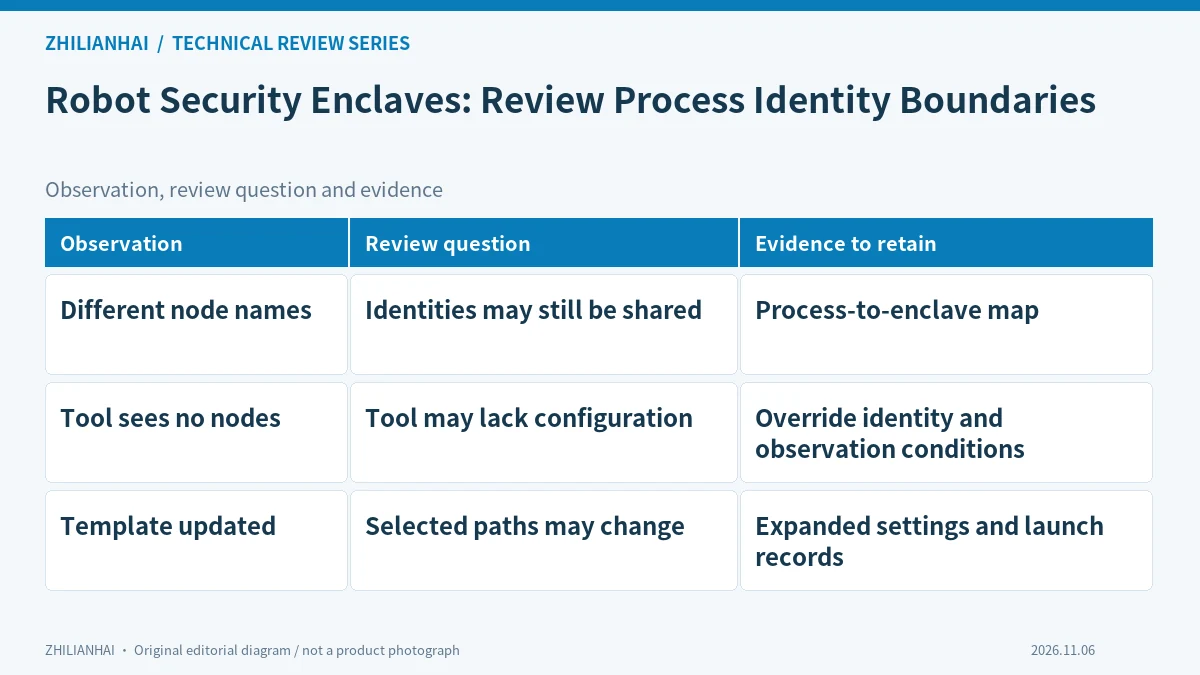
Make identity reuse an explicit decision
If several processes intentionally share materials, document the rationale, scope and change owner. Similar paths do not establish that reuse was designed or reviewed. Successful communication cannot replace that boundary decision. Include restarts and deployment updates in isolated review, checking that template changes did not silently alter the selected identity relationship.
Let the site owner choose an approved isolated way to exercise relevant exceptions. Record normal operation, the exceptional condition and recovery separately. The purpose is to establish how the application recognises and explains untrustworthy input, without requiring production equipment to act on deliberately invalid results.
Deliver a traceable identity map
Deliver the process, hosted-node, enclave, material-location and launch-revision map with actual startup evidence. Revisit it when splitting or combining processes. State the runtime combinations reviewed. One example node’s successful identity selection cannot establish equivalent coverage for every component, remote tool or alternate startup path in the robot system.
Deliver the configuration, representative samples, result table and unresolved questions together. Agree who reviews subsequent changes. The receiving team should be able to select one conclusion and trace it back to its input and decision path without relying on the original author to reconstruct the missing steps.
Original documentation and further reading
Continue with related articles in this section, or use selection guides to prepare the next review. Apply the device-specific documentation and agreed operating conditions when implementing a test.