
Robot Security: Review Enforcement Failure Behaviour
Review security enablement and enforcement independently, retaining actual launch settings and failure evidence for missing or invalid materials. This guide concerns robot integration and delivery review. The proposed observations are editorial assessment guidance, grounded in the linked original documentation and subject to the deployed version. They do not describe an on-site test of a particular machine or establish whole-system acceptance from a single interface response.
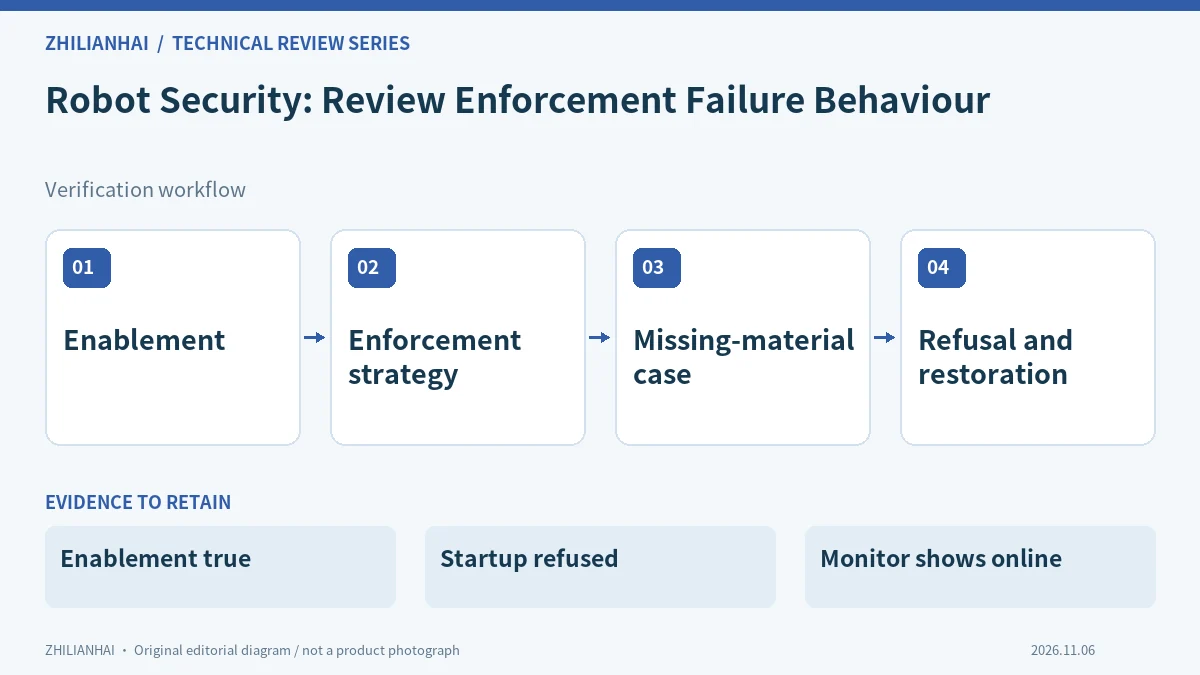
Separate enablement from enforcement
Retain effective ROS_SECURITY_ENABLE and ROS_SECURITY_STRATEGY settings and their source. The tutorial distinguishes incomplete enabled configuration that can launch without security from enforced configuration that refuses to launch when not correctly configured. Checking one enablement switch is therefore insufficient to establish enforcement behaviour for the actual deployed process.
For this review, identify the delivered device, software and configuration revisions first. Record unsupported, disabled and untested capabilities separately. Evidence from another model is useful context, but cannot establish what the delivered combination actually provides. Keep the original input beside the settings used to interpret it.
Inspect the service launch environment
Review environment supplied by the service manager, container or launcher instead of substituting values from a maintenance shell. Retain resolved keystore and enclave references. Inspect evidence again after a controlled restart so that a setting effective only in a temporary interactive session is not mistaken for persistent deployment configuration.
Retain the original input and the reason for the decision, rather than a successful screenshot alone. Change only the variables agreed for the comparison, and keep the before-and-after configuration. List conditions that were not exercised explicitly; they should not silently become part of the accepted operating range.
Define the expected failure outcome
Use an approved isolated deployment to exercise a clearly identified missing-material case. Write down the expected startup result and evidence location first. Confirm that the intended security check caused refusal rather than an unrelated dependency. Keep review materials separate from production materials instead of moving live key files merely to manufacture an error.
Use the three illustrated observations as starting questions, rather than as diagnoses of an installation that has not been inspected. Check record completeness, units and identity before selecting the next observation. An unresolved result is more informative than a confident explanation assembled from missing fields or unrelated test runs.
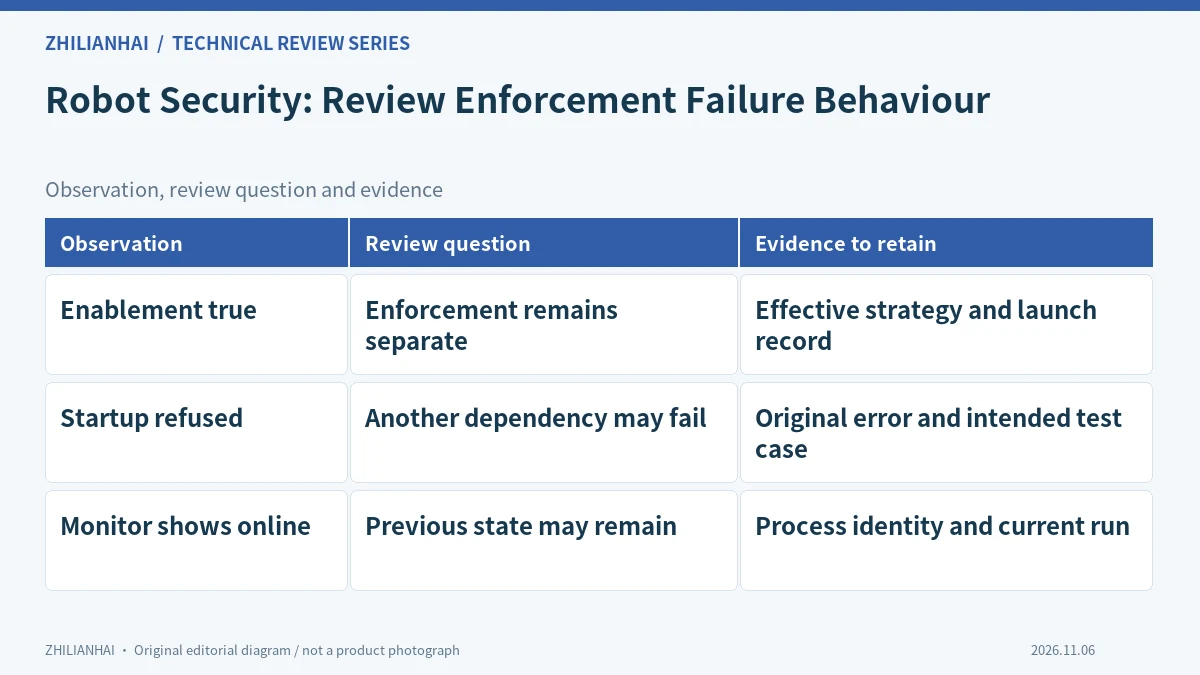
Review higher-level reporting
A correctly refused process can coexist with a stale healthy indication in another tool. Join service exit, original error and application health presentation, checking whether retries alter configuration. Startup refusal establishes one behaviour; the deployment review should also show how maintenance staff receive that result and distinguish it from a previous successful run.
Let the site owner choose an approved isolated way to exercise relevant exceptions. Record normal operation, the exceptional condition and recovery separately. The purpose is to establish how the application recognises and explains untrustworthy input, without requiring production equipment to act on deliberately invalid results.
Deliver normal and failure comparisons
Retain matched records for normal startup, refused missing-material startup and controlled restoration, with effective environment and versions. Revisit policy after launcher changes. Describe the configuration actually reviewed. A tutorial demonstration or variable name alone does not establish that every business-data path in the complete deployment has the intended protection.
Deliver the configuration, representative samples, result table and unresolved questions together. Agree who reviews subsequent changes. The receiving team should be able to select one conclusion and trace it back to its input and decision path without relying on the original author to reconstruct the missing steps.
Original documentation and further reading
Continue with related articles in this section, or use selection guides to prepare the next review. Apply the device-specific documentation and agreed operating conditions when implementing a test.