
Robot Deployment: Check Certificate and Permission Artefacts
Compare robot security artefacts, effective paths and endpoint behaviour after deployment migration instead of treating a completed copy as acceptance. This guide concerns robot integration and delivery review. The proposed observations are editorial assessment guidance, grounded in the linked original documentation and subject to the deployed version. They do not describe an on-site test of a particular machine or establish whole-system acceptance from a single interface response.
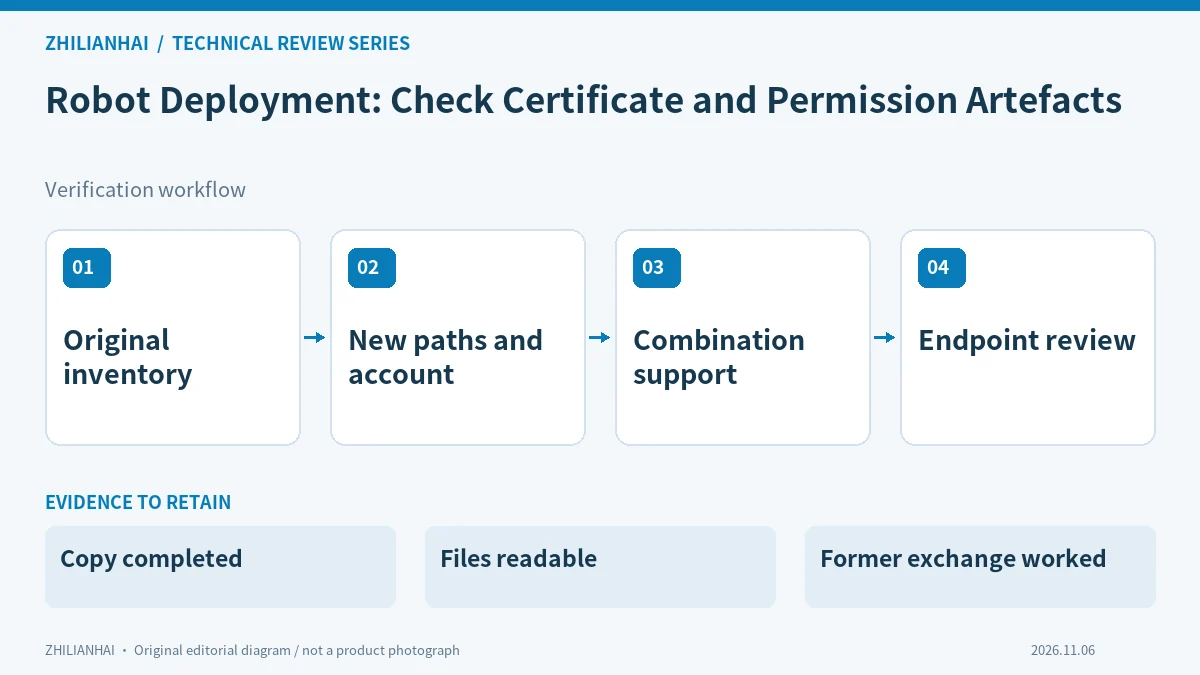
Retain the effective pre-migration inventory
Record software versions, selected middleware, enclave and material references before moving the deployment, separating templates from resolved values. Refer to controlled materials without publishing private keys. If the source environment lacks traceable configuration, record the gap. A guessed reconstruction after migration cannot establish what the earlier process actually used.
For this review, identify the delivered device, software and configuration revisions first. Record unsupported, disabled and untested capabilities separately. Evidence from another model is useful context, but cannot establish what the delivered combination actually provides. Keep the original input beside the settings used to interpret it.
Review path and runtime-account changes
Inspect launch references for obsolete absolute paths, mounts or user directories, and check access by the actual runtime account. Existing readable files must still match the selected identity. Equal file counts do not establish an equivalent deployment. Review both controlled contents and the process references that determine which contents will actually be used.
Retain the original input and the reason for the decision, rather than a successful screenshot alone. Change only the variables agreed for the comparison, and keep the before-and-after configuration. List conditions that were not exercised explicitly; they should not silently become part of the accepted operating range.
Check the supported runtime combination
Identify changes to distribution, operating system or middleware and review support for the new combination. The tutorial describes dependencies between these choices. A successful exchange on the former machine cannot simply be transferred as evidence. If only one producer-consumer pairing is observed, identify other participants as outside that review.
Use the three illustrated observations as starting questions, rather than as diagnoses of an installation that has not been inspected. Check record completeness, units and identity before selecting the next observation. An unresolved result is more informative than a confident explanation assembled from missing fields or unrelated test runs.
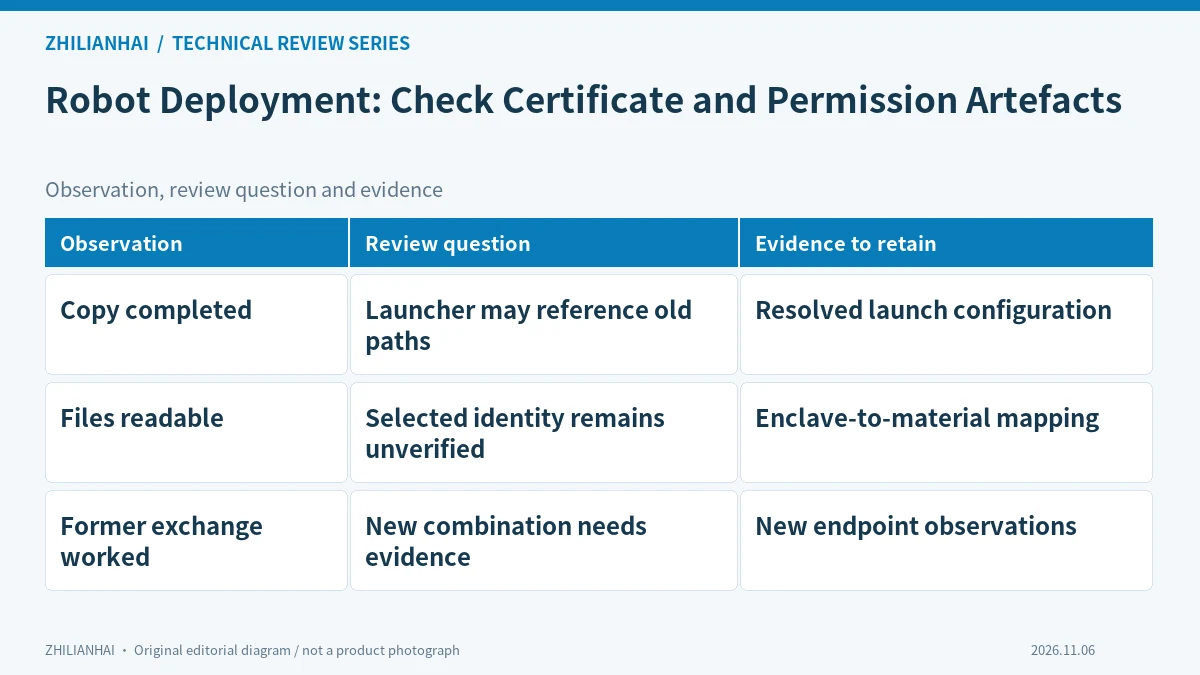
Review the actual exchange boundary
An isolated post-migration review should include valid startup, intended exchanges and expected refusal cases, retaining both endpoint identities. Maintenance tools also need appropriate security configuration; a tool’s own setup problem should not be labelled a failed business-node migration. Retain source-environment evidence so that restoration and differences remain explainable.
Let the site owner choose an approved isolated way to exercise relevant exceptions. Record normal operation, the exceptional condition and recovery separately. The purpose is to establish how the application recognises and explains untrustworthy input, without requiring production equipment to act on deliberately invalid results.
Deliver differences and uncovered combinations
Deliver before-and-after configuration differences, controlled material references, runtime observations and unreviewed combinations, with ownership for later updates. Base conclusions on the new environment’s actual records. Copy completion, extraction and directory-access checks support the migration process, but do not independently establish restored identities, exchanges and failure behaviour for every participant.
Deliver the configuration, representative samples, result table and unresolved questions together. Agree who reviews subsequent changes. The receiving team should be able to select one conclusion and trace it back to its input and decision path without relying on the original author to reconstruct the missing steps.
Original documentation and further reading
Continue with related articles in this section, or use selection guides to prepare the next review. Apply the device-specific documentation and agreed operating conditions when implementing a test.