
Laser Scan Timing: Review Per-Ray Time and Motion
Review LaserScan first-ray timestamps, per-ray timing and range validity before interpreting a moving robot’s scan as one simultaneous observation. This guide concerns robot integration and delivery review. The proposed observations are editorial assessment guidance, grounded in the linked original documentation and subject to the deployed version. They do not describe an on-site test of a particular machine or establish whole-system acceptance from a single interface response.
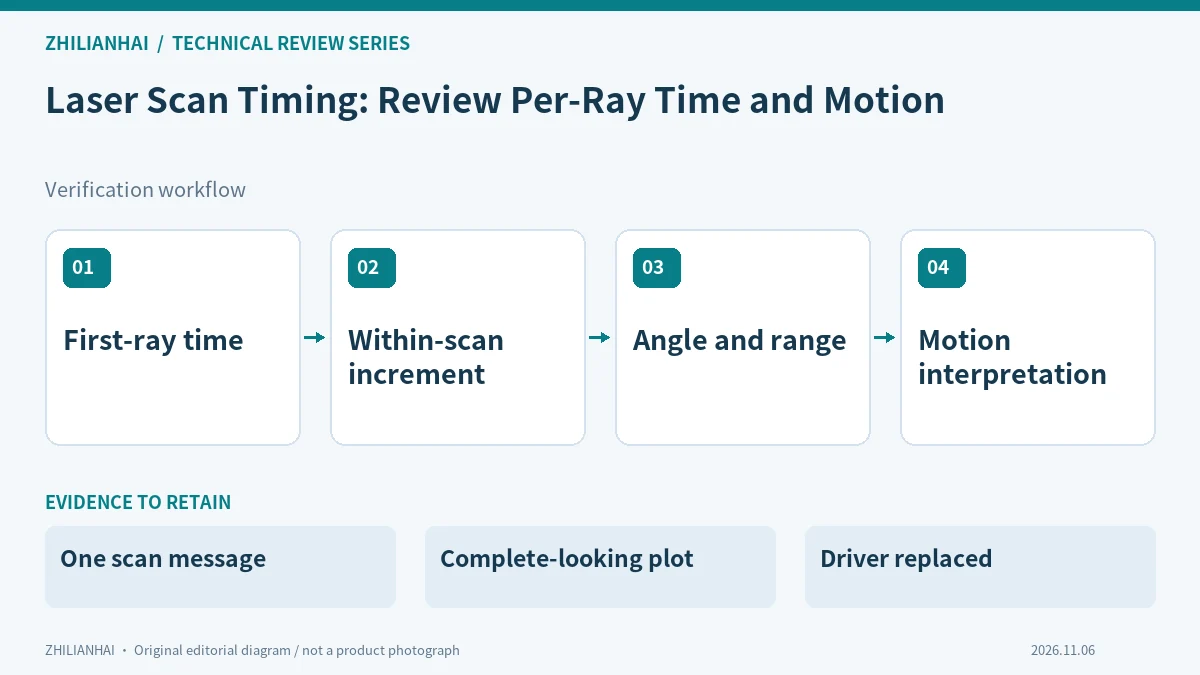
Identify the first-ray timestamp
The message definition associates header time with acquisition of the first ray. Check the actual driver’s behaviour rather than only field presence. If its timestamp denotes another instant, document the difference and handling basis so downstream code does not silently interpret a different observation boundary using the standard first-ray assumption.
For this review, identify the delivered device, software and configuration revisions first. Record unsupported, disabled and untested capabilities separately. Evidence from another model is useful context, but cannot establish what the delivered combination actually provides. Keep the original input beside the settings used to interpret it.
Separate ray spacing from scan spacing
Time_increment describes spacing between measurements, while scan_time describes spacing between scans. They are not interchangeable. Use ray indices and the driver contract to explain within-scan timing. Dividing a scan period by an assumed count cannot be presented as measured per-ray timing when the device’s actual acquisition and timestamp behaviour remain unverified.
Retain the original input and the reason for the decision, rather than a successful screenshot alone. Change only the variables agreed for the comparison, and keep the before-and-after configuration. List conditions that were not exercised explicitly; they should not silently become part of the accepted operating range.
Review geometry and validity together
Retain the relationship between angle_min, angle_increment and range indices, checking radians and metres against the definition. Treat out-of-range values according to the interface contract rather than plotting them all as valid obstacles. Separate geometric association from validity so a complete-looking display does not conceal indexing, units or range-handling problems.
Use the three illustrated observations as starting questions, rather than as diagnoses of an installation that has not been inspected. Check record completeness, units and identity before selecting the next observation. An unresolved result is more informative than a confident explanation assembled from missing fields or unrelated test runs.
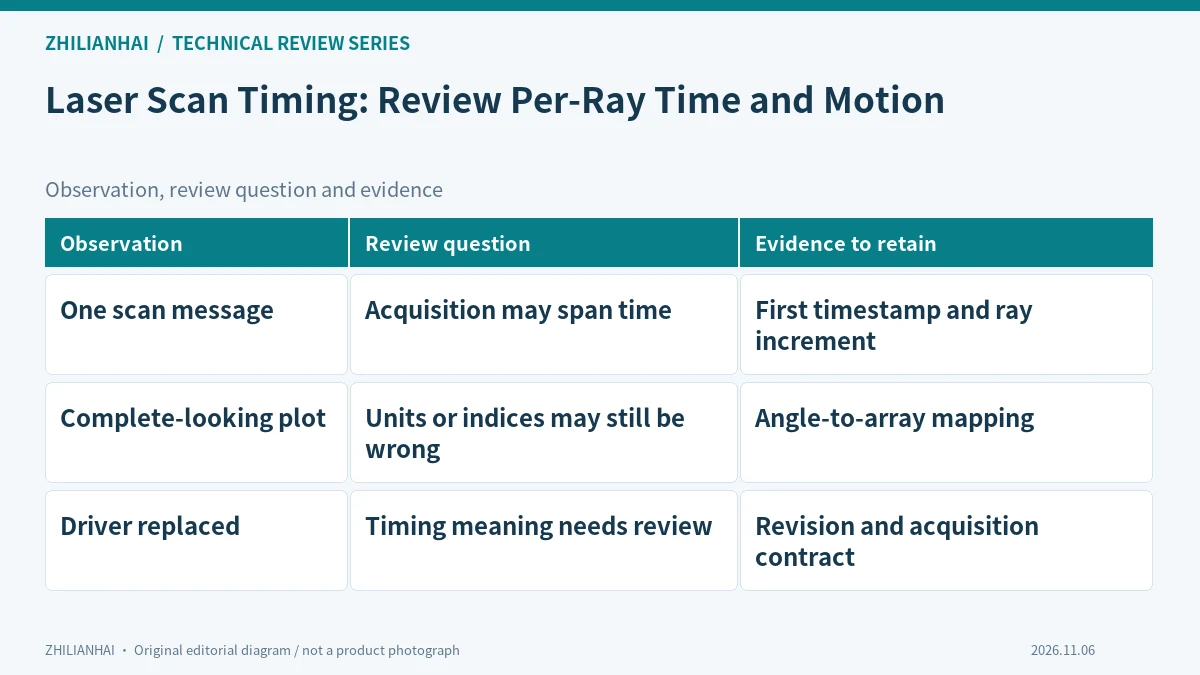
Retain evidence for motion interpretation
During robot motion, different rays can correspond to different poses. The timing field supports relevant interpolation, but the actual algorithm still needs suitable pose and clock evidence. Using the field alone does not establish complete motion compensation. Keep associated input, conversion and output samples showing the specific processing boundary the implementation actually provides.
Let the site owner choose an approved isolated way to exercise relevant exceptions. Record normal operation, the exceptional condition and recovery separately. The purpose is to establish how the application recognises and explains untrustworthy input, without requiring production equipment to act on deliberately invalid results.
Deliver scan timing and geometry contracts
Deliver driver revision, timestamp meaning, index mapping, range treatment and unresolved fields. Intensity units are device-specific, and absent intensity measurements should not be fabricated. Recheck after scanner or driver changes so continued reception of the same message type does not hide a changed interpretation of acquisition timing, geometry or validity.
Deliver the configuration, representative samples, result table and unresolved questions together. Agree who reviews subsequent changes. The receiving team should be able to select one conclusion and trace it back to its input and decision path without relying on the original author to reconstruct the missing steps.
Original documentation and further reading
Continue with related articles in this section, or use selection guides to prepare the next review. Apply the device-specific documentation and agreed operating conditions when implementing a test.