
How a Robot Mounting Surface Affects Repeatability
A robot arm can meet its published specification while its mounting surface contributes to repeatability problems. Review mounting rigidity, flatness and site vibration with the model and application conditions.
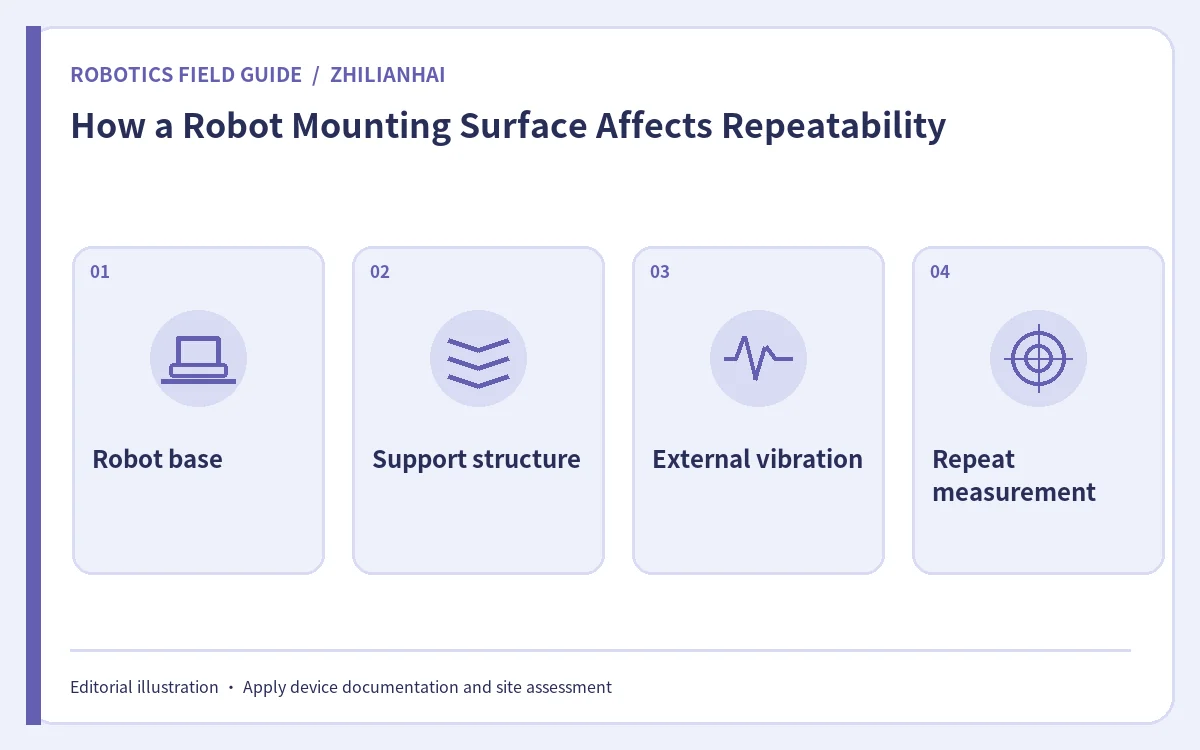
Cover image: AI-generated conceptual illustration, not a photograph of an actual product or project.
Check mounting requirements
Compare the actual model’s base interface, fastening method and allowed orientations with the support design. Do not transfer hole patterns or fastening requirements from a different model.
Identify external vibration
Nearby presses, conveyors or a mobile platform can transmit vibration into the support. Record when it occurs, neighboring equipment state and affected poses to distinguish external inputs from robot motion.
Compare like conditions
Keep tool, part, program and measurement method consistent while comparing nearby equipment on and off. Qualified measurement is needed; one positional difference does not establish robot repeatability.
Deliver the installation record
Retain foundation drawings, installation inspection, fastener maintenance and repeat measurements. Recheck affected references and application risks after structural changes or remounting.
Applying the checklist: a hypothetical example
Suppose measurements vary at one pose only when a nearby press is operating. Retain time, pose and measurement method, then compare conditions with the press running and stopped when safe and authorized. One difference is a lead; support adequacy still needs professional assessment.
Sources and application limits
This guide refers to Universal Robots: deployment considerations. Examples and review steps are editorial guidance; use the documentation for the actual device and qualified assessment.
Continue to company directory and robot selection guides.