
Keep Robot Cables Clear of Motion and Excessive Bending
Robot tool cables move repeatedly with the joints. Routing must respect supplier bend requirements and the full range of workcell motion; a tidy stationary cable can still snag or be pinched in motion.
Cover image: AI-generated conceptual illustration, not a photograph of an actual product or project.
Map the full motion
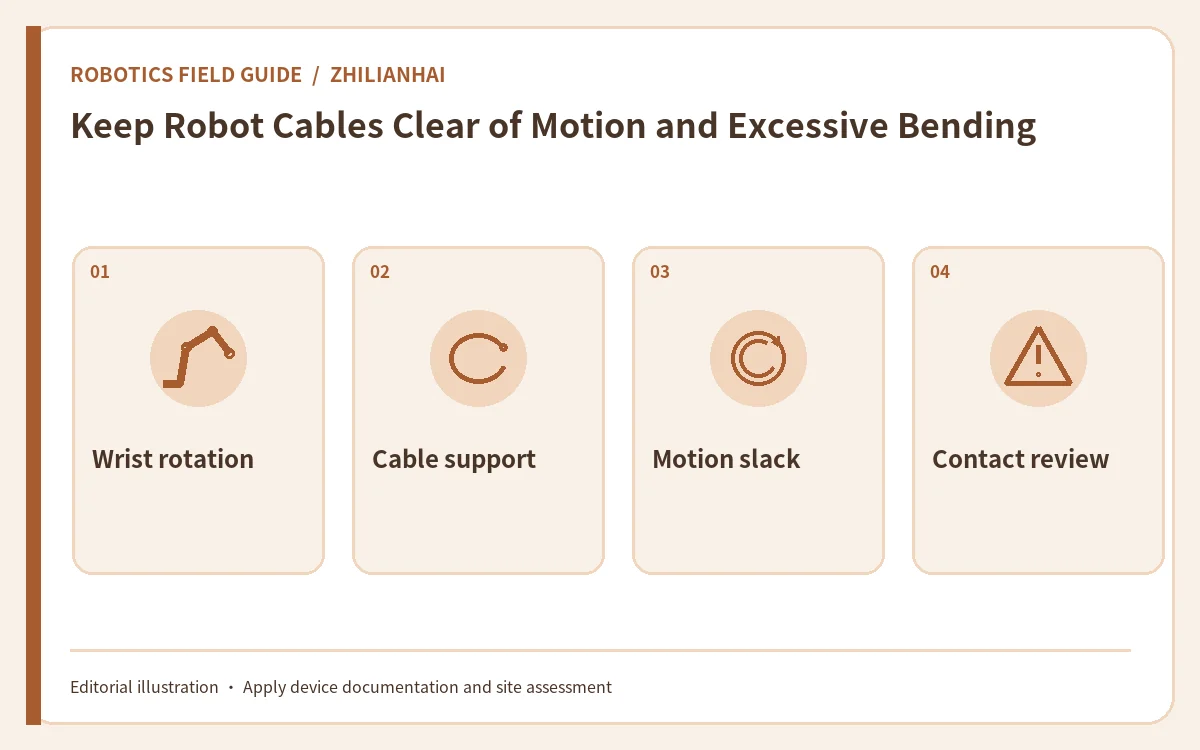
Mark joint, tool, fixture and part movement through all task poses, especially wrist rotation and connector areas. Update the review whenever paths change.
Check cable-specific limits
Distinguish static routing from repeated motion requirements and confirm connector and carrier limits. One bend radius should not be assumed suitable for all cables.
Inspect contact and slack
Under controlled conditions, observe sharp-edge rubbing, pinching and tension at extreme poses. Excess slack can introduce another snag hazard.
Keep maintenance evidence
Record cable type, supports, protection, replacement date and wear locations. Perform maintenance using site energy isolation and manufacturer instructions.
Applying the checklist: a hypothetical example
A cable may touch a bracket only near a particular wrist pose, which a stationary photo misses. Record the program segment and contact point, check the full movement safely, and review supports against the cable and robot documentation.
Sources and application limits
This guide refers to Universal Robots: deployment considerations. Examples and review steps are editorial guidance; use the documentation for the actual device and qualified assessment.
Further reading: UK HSE work equipment maintenance guidance.
Continue to company directory and robot selection guides.