
Verify Cell Behavior When an Interlocked Guard Opens
An interlocked guard review must consider the whole application, including the arm and associated machinery. A responsible team should define a controlled validation plan before testing.
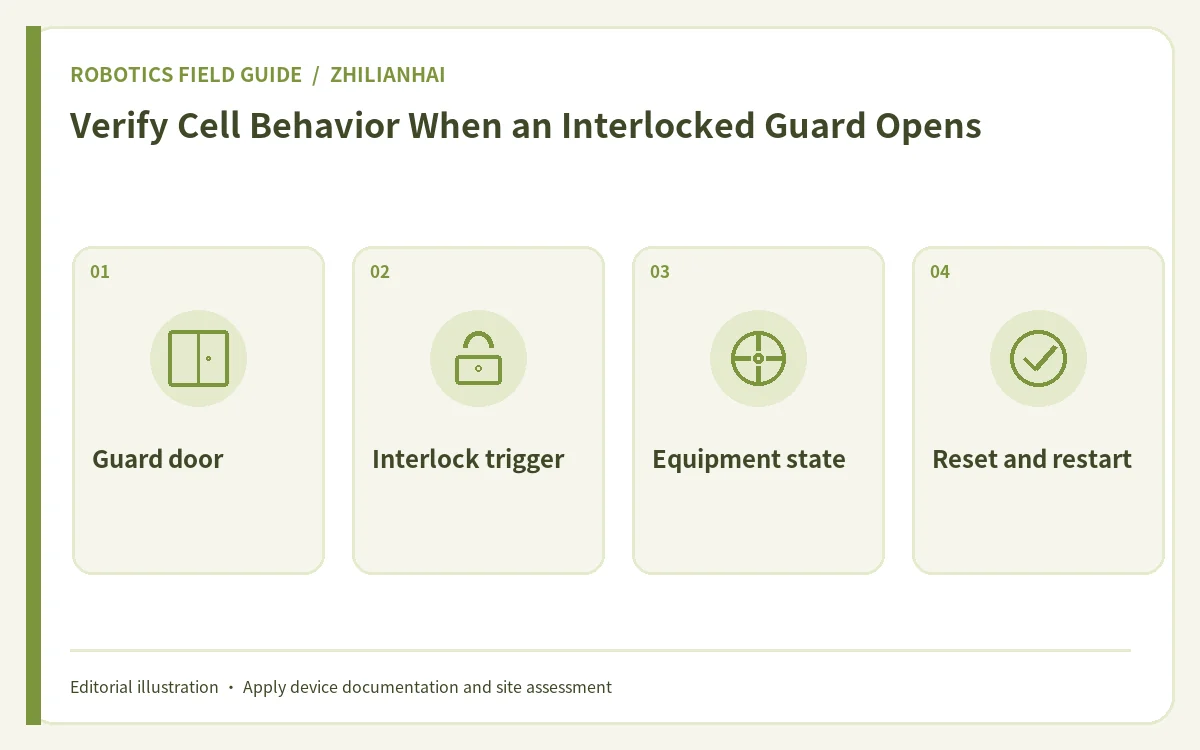
Cover image: AI-generated conceptual illustration, not a photograph of an actual product or project.
Identify the guard and scope
Record the door, interlock and associated robot, conveyor and tooling expected to be affected. Include each access point.
Validate under an approved plan
Qualified personnel should observe triggering, stopping and status indication under safe conditions and the equipment documentation and site risk assessment. Record the mode and starting state.
Review closure and reset
Check the designed state after closing, reset requirements and authorization to restart. Closing a door does not automatically establish that a start is appropriate.
Retain revisions and results
Record device, control-configuration revision, results, findings and retest. Reassess after guard modifications or interlock replacement.
Applying the checklist: a hypothetical example
A cell may have front and rear guard doors. Passing the front-door test does not establish the rear door’s behavior. List each access point and associated equipment and record stopping, indication and reset under an approved plan.
Sources and application limits
This guide refers to Universal Robots: application risk assessment. Examples and review steps are editorial guidance; use the documentation for the actual device and qualified assessment.
Continue to company directory and robot selection guides.