
Review Hazard Zones Where a Robot Meets a Conveyor
Where a robot meets a conveyor, mechanical motion and part transfer can overlap. Assess both machines and their coordinated states.
Cover image: AI-generated conceptual illustration, not a photograph of an actual product or project.
Map the transfer area
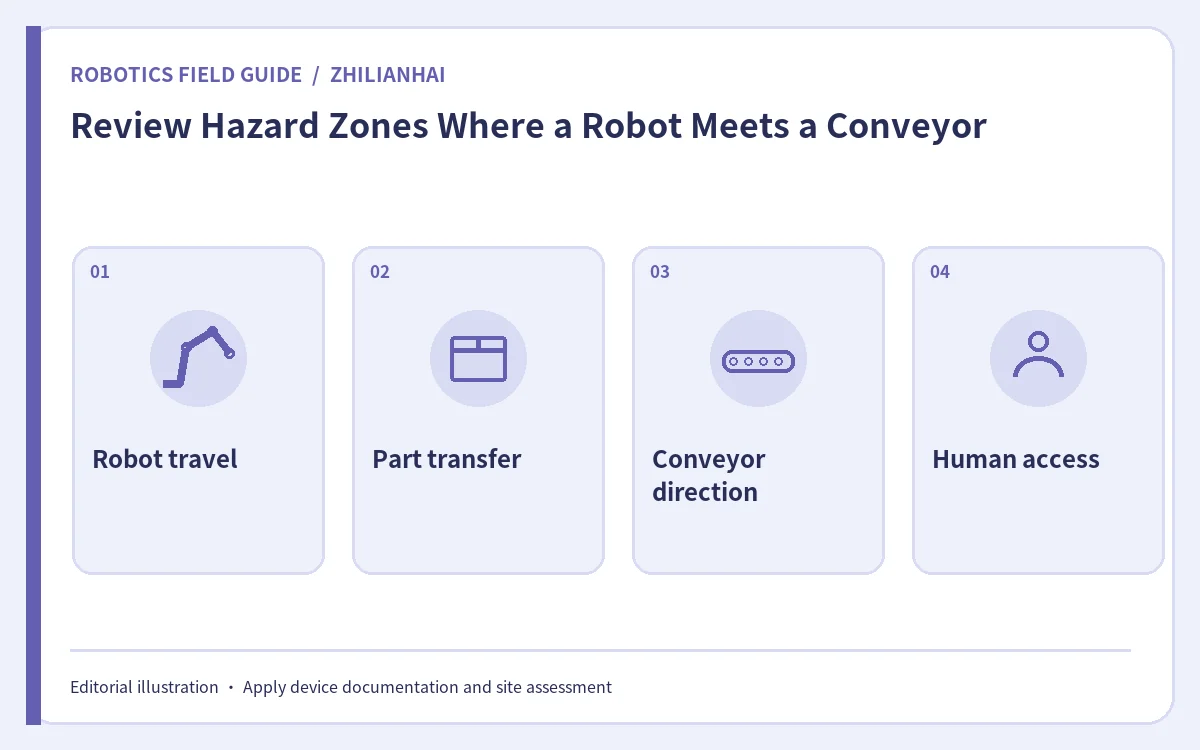
Mark robot travel, conveyor direction, part dimensions and possible human access, including jams, cleaning and maintenance.
Review control boundaries
Identify how each machine starts, stops and resets and how interlocks and signals are designed to work in each mode. A robot-controller status alone is insufficient.
Assess exceptions
Review jams, dropped parts, communication loss and manual removal. The integrator and site owner should determine safeguards and validation.
Retain interface validation
Keep interface diagrams, configuration revisions, test plans, results and changes. Reassess related risks after conveyor or tool modifications.
Applying the checklist: a hypothetical example
A conveyor and robot can handle the same part yet respond differently when the arm stops. The design team should confirm interlock scope, exception handling and site validation; one indicator cannot establish the safety of the whole cell.
Sources and application limits
This guide refers to Universal Robots: application risk assessment. Examples and review steps are editorial guidance; use the documentation for the actual device and qualified assessment.
Continue to company directory and robot selection guides.